
From an 8-year-old’s promise to a doctorate rooted in home
UC Davis nursing graduate hopes to bring trust, dignity and lasting care back to her rural tribal community
At a young age, Cecilli Gonzales was inspired to pursue a career in health care by her great-grandmother Elizabeth Case. Case was a respected Karuk medicine woman, tribal leader and advocate for Native people from the Quartz Valley Indian Tribe near the California-Oregon border.
As her great-grandmother entered the final chapter of her life, Gonzales wished she had the knowledge and ability to help ensure she was comfortable and cared for with dignity. The experience, combined with the values and teachings passed down by her great-grandmother, inspired a lifelong commitment to serving others through health care.
"Watching someone I loved enter the final chapter of her life made me want to learn how to care for people and support families during difficult times," Gonzales said.
That inspiration stayed with her throughout her educational journey.
Years later, Gonzales graduates from the Betty Irene Moore School of Nursing at UC Davis with a Doctor of Nursing Practice — Family Nurse Practitioner degree, becoming the first person in her tribe to earn a doctorate.
Growing up where support is hard to reach
Gonzales grew up in Quartz Valley, where access to healthcare can mean hours of driving through mountain roads for specialty appointments.
“There’s one community we work in, where their only store is just like a little gas station market,” Gonzales said. “They have to travel hours to get to a grocery store where there’s fresh food.”
In her community, clinics are often understaffed. Patients wait months for appointments. Many rely on telehealth visits with providers they may never meet in person. She also understands another barrier: mistrust.
Gonzales said her commitment to health care is also shaped by conversations she has had with family members over the years.
"My grandfather always says, 'I don't want to go to the hospital because that's where people go to die,'" Gonzales said. "Hearing that made me realize that access alone isn't enough. People need to feel safe, respected and understood. I want Native people to see health care as a place where they can find healing, support and dignity."
Care focused on dignity beyond diagnosis
For Gonzales, health care is not simply about treating illness it's about preserving dignity, rebuilding trust and carrying forward the teachings of those who came before her.
As a Native American woman with Karuk and Navajo ancestry who was raised in the Quartz Valley Indian Tribe community, Gonzales said generations of trauma and mistreatment within health systems continue to shape how many tribal members approach health care today.
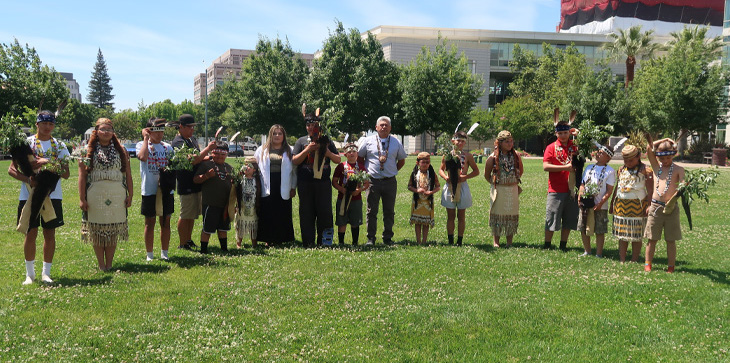
Tribal leaders delivered remarks and youth performed as Cecilli Gonzales shared doctoral work inspired by her community.
“The impact of historical trauma is still felt in many Native communities and is often not fully understood within health care systems,” she said. “I wanted people to know they were being cared for by someone who understands their community, culture and history."
That commitment to culturally grounded healing became central to Gonzales’ work at the School of Nursing, where faculty say she brought both personal experience and professional purpose into every aspect of her doctoral education.
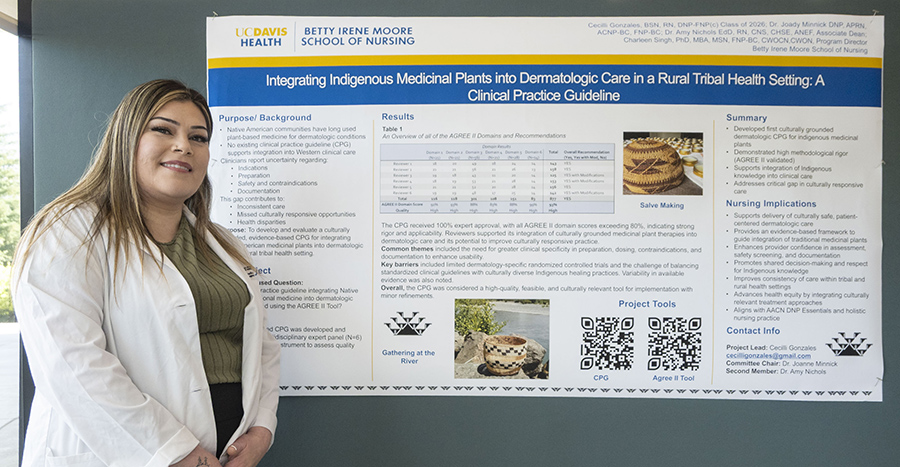
“Cecilli’s doctoral work integrating traditional Native medicinal plants into dermatologic treatment demonstrates exceptional leadership, cultural humility and the ability to bridge evidence-based practice with Indigenous healing traditions,” said Assistant Professor Jody Minnick, Gonzales’ committee chair. “Healthcare is improved by leaders like Cecilli whose compassion, lived experience, and dedication to advancing health equity strengthen trust and culturally congruent care.”
Building a future one step at a time
Gonzales never imagined earning a doctorate would truly be possible.
A first-generation college student, she said she did not know how to apply for financial aid, register for classes or navigate higher education.
“Nobody’s done it before you,” she said. “Nobody can be like, ‘Hey, this is how you do it.’”
She began as a Licensed Vocational Nurse, then became a Registered Nurse, earned a bachelor’s degree and eventually enrolled in UC Davis’s three-year DNP-FNP program while raising children and working in tribal health.
“There were times where I was just like, there’s just not enough time in the day,” Gonzales said.
Still, she kept going.
The program’s hybrid structure allowed her to remain in her rural community while completing clinical placements close to home.
“I probably would have never followed through with my dream of being a nurse practitioner,” she said.
A promise carried forward
Recently, members of her tribal community traveled to Sacramento to support her doctoral symposium presentation. The chairman of the Quartz Valley Indian Tribe delivered remarks and tribal youth performed a demonstration Brush Dance, sharing elements of a traditional Karuk World Renewal ceremony that continues to be practiced today. The performance reflected the same cultural teachings and traditions that Gonzales' great-grandmother, Elizabeth Case, encouraged future generations to share and preserve.
"She always said, 'Go out and share your culture to let them know that we're still here,'" Gonzales said. "She believed it was important for people to understand that Native communities remain strong, resilient, and connected to our traditions."
Now, as commencement approaches, Gonzales reflects on the teachings and example set by her great-grandmother and the responsibility she feels to continue serving Native communities.
For Gonzales, earning a doctorate is not only a personal achievement but also an opportunity to carry forward the values of service, cultural preservation and advocacy that were modeled by her great-grandmother and other tribal leaders who came before her.
"I hope I am honoring the legacy she created for our people," Gonzales said.