

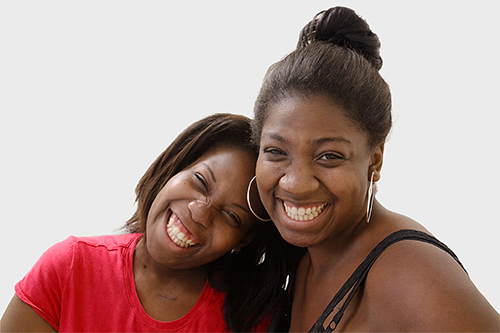
Before she fell asleep for surgery, Elisabeth Lucien had an ‘A’ blood type. After she awoke from anesthesia, she had an ‘O’ blood type. That’s not a surprise because following a bone marrow transplant, a patient’s blood type often changes to that of their donor.
In Lucien’s case, the blood type — and the bone marrow — came from her sister, Rebekah Fenton.
This was Lucien’s second bone marrow transplant at UC Davis Comprehensive Cancer Center.
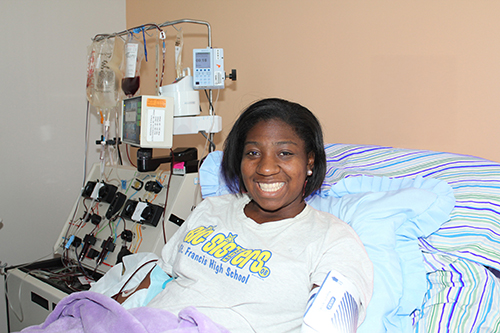
She was diagnosed with Hodgkin’s lymphoma in 2009, at the age of 17, and had an initial bone marrow transplant in 2010. That one was autologous, meaning physicians collected Lucien’s own stem cells then returned them back into her body after intense chemotherapy and radiation. Unfortunately, the lymphoma came back. Lucien would need another round of chemo and a second transplant, this time from a donor.
Luckily, a donor wasn’t hard to find.
Care should feel like home
Fenton (formerly Lucien) is a little more than a year older than Elisabeth. They were both born in Sacramento although they insist they “grew up” at UC Davis Medical Center. Their father, Michael Lucien, attended UC Davis School of Medicine, stayed for his residency and is the current associate chief of the UC Davis Health Community Physicians Group. Their mother, Darreis Lucien, is a nursing professor at Sacramento City College; her students rotate at UC Davis Health.
In September, Fenton also joined UC Davis Health as a pediatrician and adolescent medicine physician. Her approach to adolescent care grew from her sister’s journey with cancer.
“I was inspired by her determination to be a normal high school student,” remembered Fenton. “She was literally bargaining with her doctors.”
‘Finding’ a match
Upon learning she would need a bone marrow donation, Lucien faced the odds. Though five-year survival rates are 90% for Hodgkin’s lymphoma, 70% of patients won’t match with their family members. And the chance of finding a match through a donor registry is significantly lower for African American people (29%).
Both of Lucien’s siblings were tested. While her brother was not a match, her older sister was a slam dunk. For Fenton, it was a “no-brainer” that she would donate.
But her sister wasn’t so sure. “I’m not letting her do it,” thought Lucien. “She’s leaving for med school. I don’t want her to sacrifice anything.”
For a while, Fenton let her little sister process her feelings, her sense of guilt for needing help. She knew she would come around; she just needed some space. Meanwhile, Fenton had her own fears: “What if the transplant doesn’t work and I’m responsible for any negative outcomes?” she thought.
She leaned on a medical school mentor for emotional guidance and found a donor support network. There, she bonded with another woman who had also donated to a sibling. Her own strong faith sustained her spirit.
“Before my sister was born, God knew I was going to be a match for her,” Fenton said. “My blood is a gift that I have no control over. I trust it, I surrender. I hope, because of God, that it becomes the life I get to see her live.”
Soon, Lucien sent her older sister a text. It read, “Fine, you can do it.”
As if it were ever a question. Fenton donated her sample.“I’ll never forget it,” said Lucien, through tears. “Like, she is my hero. There are no words for that day, seeing her do that. I feel like I owe her my life.”
But in the weeks leading up to the transplant, guilt weighed on her. “I have to find some way to repay her,” she repeated.
The day before the transplant, Lucien was in a dark place, overwhelmed by years of treatment and her upcoming procedure. She froze. She wouldn’t move or talk to anybody in the hospital. Her doctor called it “playing possum.”
Then her sister called. She had filmed a video to lift her little sister’s spirits. Lucien watched it through tears. She was finally ready for the procedure.
The ‘Sister Act’
As soon as she woke and learned her new blood type, Lucien called her sister. “You’re in me,” she joked.
Thereafter, in honor of a successful transplant and Lucien’s remission, the sisters celebrate each anniversary of the procedure. November 9, 2025, marked 13 years. They call it “Sister Act Day.”
Lucien doesn’t often talk about what she went through. Years of battling Hodgkin’s lymphoma took a heavy emotional toll. However, it inspired her to earn a Master of Social Work in 2019 from the University of Southern California and a Ph.D. in sociology in 2025 from Howard University. She is a speaker for mental health awareness and plans to open a virtual psychotherapy practice.
She hopes sharing her story will not only inspire patients but help educate care teams. She wants medical professionals to remember the human behind the diagnosis.
“I’m really thankful for each and every one of them,” said Lucien. “At UC Davis, it’s like you become family.”
Lucien doesn’t remember it, but her father actually carried her as an infant across the stage as he accepted his diploma from UC Davis Medical School.
“It’s like coming back home,” added Fenton, two months into her new role. She chose to share their story to honor “the gift this institution has given my family.”
Like, she is my hero. There are no words for that day, seeing her do that. I feel like I owe her my life.” —Elisabeth Lucien