
Standardized Patient Actors
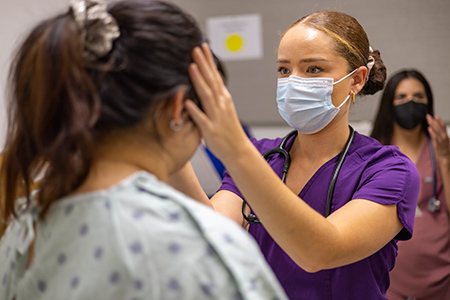
A standardized patient is a trained individual who simulates real patient scenarios to help learners practice clinical and communication skills.
They portray a wide range of cases, from routine exams to complex or end-of-life situations. Students engage with them in small groups and clinical settings under the guidance of experienced clinicians, creating a safe, realistic environment to build essential skills. Through hands-on interaction and structured feedback from faculty and peers, learners develop the confidence and competence needed for real patient care.
We integrate standardized patients into clinical training for students at the UC Davis School of Medicine and the Betty Irene Moore School of Nursing.
Standardized patients are responsible for:
- Memorizing and accurately portraying a patient's persona, including medical history, symptoms, and relevant details.
- Participating in limited physical examinations, such as pulse checks, blood pressure readings, and listening to heart and lung sounds.
- Providing clear, constructive written and verbal feedback to help learners improve clinical and interpersonal skills.
- Maintaining punctuality and reliability, as sessions and exams depend on their timely participation.
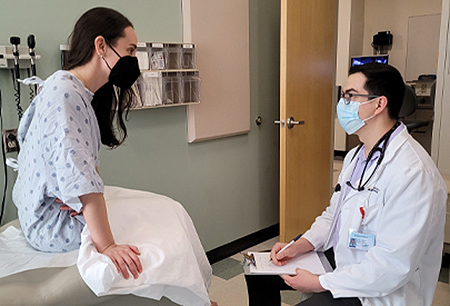
Become a Standardized Patient
We are looking for a diverse group of standardized patients of all ages, races, ethnicities, religions, body types, gender identities, and sexual orientations. No prior acting experience is required, and anyone in the community who wants to help train the next generation of medical professionals is welcome.
Standardized patients work on an intermittent, contract basis and are paid a per diem rate for their time. We recruit year-round and regularly hold auditions via Zoom, with in-person callbacks as needed. This is a unique opportunity to contribute to medical education while gaining valuable experience in a professional learning environment.
To learn more about the standardized patient program, email standardizedpatients@health.ucdavis.edu or call 916-734-5201
FAQs
- Must be reliable and punctual
- Adhere to policies and protocols
- Attentive to scripted details and training instructions
- Full engagement and focus during training sessions
- Conscientious, respectful and focused while working on campus
- Have great communication and interpersonal skills
- Able to portray a specific standardized patient role, for potentially multiple consecutive times, providing each student with the same patient
- experience
- Keep information such as scripts and student encounters confidential
- Exhibit no biases towards race, ethnicity, religion, age, appearance, gender identity or sexual orientation
- Have excellent memory recall for scripted information
- Willing to be videotaped for educational purposes
- Understand that the focus of each encounter is on the student, and the goal of each encounter is to further the educational experience for the student
Standardized patients must be at least age 18 to participate in the program. Otherwise, there is no age limit as we keep our standardized patient pool diverse for the most realistic representation of the community.
People do not need to be actors or have prior acting experience to be outstanding standardized patients. This work can build on skills actors are familiar with, such as memorization and improvisation, but being an actor is not a prerequisite for the program.
Prior knowledge about medicine or health care is not required. Each case script has all the information needed to portray the case correctly. All medical information is covered during the training session, and clarification on any terms or aspects of the case is addressed as needed at that time.
It is important that our standardized patients disclose their previous health history, and we request this information during the onboarding process.
This helps our team determine if there is a previous health history that might affect the case portrayal or cause issues for a student during the physical exam.
For example, if a standardized patient has a condition that causes loss of sensation in their feet, and they are asked to play a person with normal sensation, this could pose an issue that would preclude the patient actor from participating in that specific case.
Medical history, such as surgical scars or other minor issues, can typically be worked around, as long as our team knows in advance so that we can make the necessary adjustments.
Our standardized patients receive a detailed case script with all of the pertinent information. This is followed by a training session with other standardized patients who are also working with the same script. This ensures we are able to standardize portrayals and address any case questions.
For each scripted case, there is an in-depth training session that addresses all the specifics of what is required. Standardized patients then engage in a long-form, given-circumstances improvisational encounter with the students based on the scripted information and the parameters set forth during the training session.
Standardized patients are asked to participate in non-invasive physical exams, which can include things such as listening to the heart and lungs, testing reflexes and sensation, examining the abdominal area, assessing strength and range of motion for muscles and joints, and other such assessments.
Standardized patients are required to change into a patient gown since all clinical encounters take place in an exam room. However, standardized patients are asked to keep their undergarments on underneath the gown (e.g., underwear, shorts, bra or sports bra).
There are cases that require standardized patients to complete a checklist to verify what a student did or did not do during an encounter. Some cases also require productive written or verbal feedback on students’ interpersonal skills. Standardized patients may accept or decline these cases based on comfort level with cognitive recall or offering feedback.
The students understand that our standardized patients are not real patients and that the ailments portrayed are not real.
Standardized patients are independent contractors and the work offered is sporadic in nature. Patient actors are contacted for sessions based on scripted demographic and skill level requirements. This means that they may work as often as once a month or a little as once a year. There is not a guaranteed number of days or hours.
Absolutely! We compensate very well. Specific pay rates are discussed during the onboarding process.
Standardized patients are not required to play every role we reach out to them about and passing on a role does not hinder their ability to work in the future. We only ask that our standardized patients maintain communication and let us know if they are unable to participate in any sessions offered.
We require proof of vaccination against COVID-19 before hiring our standardized patients.