

Robotic-Assisted Orthopaedic Surgery
The state-of-the-art robotic surgery program at UC Davis Health features a dedicated team of highly experienced surgeons, nurses, and technicians. Our specialists are extensively trained in robotic-assisted orthopaedic procedures and perform numerous joint replacement surgeries using the latest robotic systems, including Mako SmartRobotics™.
This innovative approach results in a more tailored, minimally invasive surgical experience, offering the potential for quicker recovery and improved implant longevity. By integrating robotics into orthopaedic care, UC Davis Medical Center is dedicated to improving surgical consistency, reducing recovery times, and optimizing long-term outcomes for patients with a variety of conditions, including:
- Developmental hip dysplasia
- Hip osteoarthritis
- Hip osteonecrosis
- Knee osteoarthritis
- Partial knee replacement
- Post-traumatic arthritis
- Rheumatoid arthritis and other inflammatory arthropathies
- Shoulder Replacement
- Total hip replacement
- Total knee replacement
Robotic Orthopaedic Surgery: The Mako SmartRobotics™ Device
What is the Mako SmartRobotics™ Device?
Knee Replacement (Total and Partial):
- Before surgery, the Mako system creates a detailed 3D model of the patient’s knee using a CT scan. This allows surgeons to develop a personalized surgical plan tailored to the patient’s unique anatomy.
- During the operation, the surgeon uses the Mako robotic arm to precisely remove only the damaged bone and cartilage, preserving as much healthy tissue as possible.
- The system provides real-time feedback and haptic (tactile) guidance, ensuring that bone preparation and implant placement match the preoperative plan.
- This level of accuracy helps improve the alignment and fit of the implant, which can lead to better joint function, less pain, and longer-lasting results.
Learn more about Knee Replacement Surgery
Hip Replacement:
- For total hip replacements, a preoperative CT scan is used to generate a 3D model of the patient’s hip. The surgeon uses this model to plan the optimal size, position, and alignment of the hip implant.
- During surgery, the Mako system guides the surgeon as they prepare the hip socket and position the new implant components.
- The robotic arm ensures that the bone is prepared precisely to the planned depth and orientation, which helps achieve accurate leg length and joint stability.
- This precision reduces the risk of complications such as implant misalignment, dislocation, or uneven leg length.
Shoulder Replacement:
What is reverse shoulder replacement?
What happens during the shoulder replacement procedure?
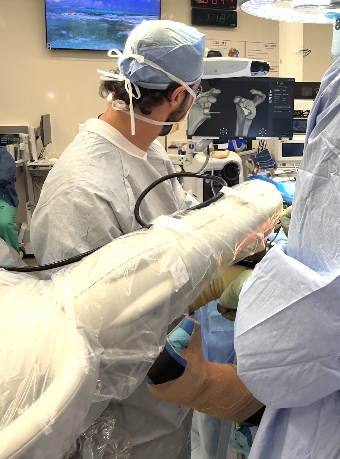
- During a Mako-assisted reverse shoulder replacement, the surgeon removes the worn joint surfaces and uses the robotic arm to precisely prepare the socket (glenoid) and upper arm bone (humerus) based on a detailed 3D plan.
- The new implant components are then placed with a high degree of accuracy.
- After the procedure, the wound is closed and the patient’s arm is placed in a sling to support healing.
Benefits for Patients
By combining the expertise of skilled surgeons with the latest robotic technology, the Mako SmartRobotics™ system offers a new level of precision and personalization in shoulder replacement surgery.
- Guided precision in the OR: A robotic-arm can help reproduce the preoperative plan exactly as intended, keeping drills and reamers on the correct angles and depths while the surgeons stays in full control.
- Fewer extreme placement errors (“outliers”): Robotics is especially helpful in tough bone or deformity, where avoiding big positioning mistakes matters most.
- Better management of bone loss: Real-time guidance lets surgeons optimize baseplate position and screw fixation to maximize stability with the bone available.
- Consistent results across cases: The system adds repeatability—even when anatomy is variable—aiming for dependable alignment case after case.