Emergency CareDecember 15, 2025
‘Simple fix’ restores vertigo patient’s quality of life
Within minutes, trained physical therapists can provide relief from an extremely disorienting condition

A mom to a new baby, Angela Robertson hadn’t been able to play with her infant daughter on the floor for over a month. She couldn’t rest in an upright position or lie on her left side. After suffering a vertigo episode, she’d lived with debilitating dizziness for weeks. She was exhausted.
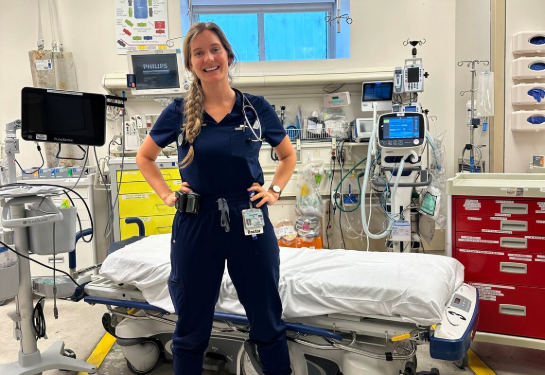
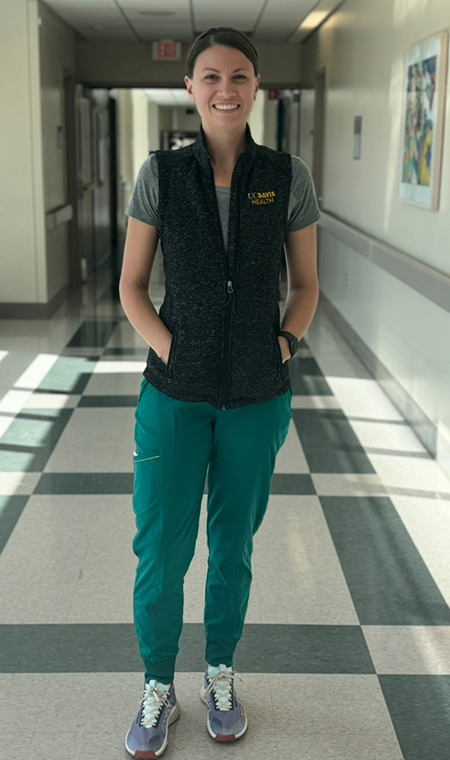
On a particularly bad day, she visited the UC Davis Emergency Department (ED). There she met Kathleen Turley, one of eight vestibular physical therapists on the Department of Physical Medicine and Rehabilitation team. Turley and her fellow therapists frequently support ED cases of acute vertigo.
What causes vertigo?
Vertigo is the illusion of movement. A person may feel as if they or the room are spinning, tilting, or shifting despite remaining completely still. This sensation often indicates an issue within the vestibular system — an inner-ear structure responsible for maintaining balance and spatial orientation. Because of its central role in equilibrium, the vestibular system is one of the first areas clinicians assess when a patient presents with vertigo.
One common, inner-ear cause of vertigo is benign paroxysmal positional vertigo (BPPV). BPPV occurs when tiny “crystals” in the inner ear, known as otoconia, dislodge from their usual location and migrate into one of the three semicircular canals. These crystals normally help the brain interpret head movement and position. When displaced, a person may feel sudden, intense episodes of vertigo — dizziness, nausea, a spinning sensation or the feeling of falling.
“People can get very ill, with severe nausea and vomiting,” Turley said.
For Robertson, who is a physical therapist herself, vertigo and dizziness were all-consuming. “The toll on my quality of life was immense,” she said. “I was fatigued, frustrated and discouraged.”
Speedy, specialized relief
In the ED, Turley conducted a comprehensive vestibular evaluation, which includes a neurological screen and tracking Roberton’s eye movements with high-tech infrared goggles. After providers rule out more complex diagnoses, Turley and her team often perform positional testing for BPPV. If confirmed, they offer a simple treatment called a canalith repositioning maneuver — basically, moving a patient’s head in three to four different positions to get the crystals back where they belong.
“It's very rewarding because it's something we can often fix within minutes, and for such horrific symptoms,” Turley said.
It's very rewarding because it's something we can often fix within minutes, and for such horrific symptoms."—Kathleen Turley, vestibular physical therapist
For such a quick solution, the ability to assess and treat these conditions requires more than foundational physical therapy training. UC Davis Health invested in additional training for vestibular team members so they can perform comprehensive vestibular evaluations, support physicians in differential diagnosis and provide timely, effective assessment and treatment for patients.
Lasting emotional impact
Just as important, though, is a compassionate bedside manner. Patients with vertigo often feel terrified, understandably leading to panic, anxiety and physical imbalance.
“In cases like this of BPPV, getting the patient’s consent and buy-in is sometimes more challenging than performing the maneuver itself. To ‘fix’ the vertigo, we must briefly trigger their symptoms, which can cause nausea and vomiting before true resolution occurs,” Turley said.

Yet she excels at it, according to her manager Acute Care Physical Therapy Supervisor Vaiao Tuala. “Kat approaches each patient encounter as an opportunity to make someone’s life better. Any individual seeking care at UC Davis would be exceptionally fortunate to have her expertise as their physical therapist.”
For Robertson, trust had already been established. She had been hospitalized with BBPV the prior year, when she was pregnant. Turley, along with three other vestibular team members, had treated her then, too.
“Because of her expertise, I was able to return to my family and my work with renewed hope and stability,” Robertson said. “There is no price that can be placed on regaining one’s quality of life, and I am immensely thankful.”