Historic study looks at cancer risk in Asian Americans
By Stephanie Winn
UC Davis enrolling Vietnamese and Hmong participants from Sacramento-area communities
(SACRAMENTO)
Cancer is already the leading cause of death among Asian Americans, yet this group remains severely understudied in U.S. cancer research. TheASPIRE (Asian American Cohort Study), funded by theNational Cancer Institute, is emerging as one of the most significant public health initiatives ever launched to understand cancer disparities among Asian Americans. Now the study has come to the Sacramento region.
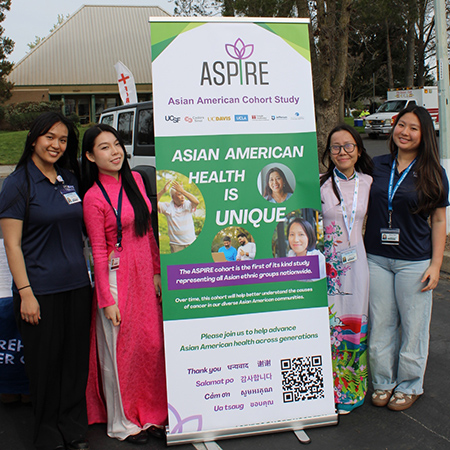
UC Davis ASPIRE team (left to right) Lydia Nguyen, Kathy Tran, Hien Ngo and Nancy Tran at a recent outreach event.
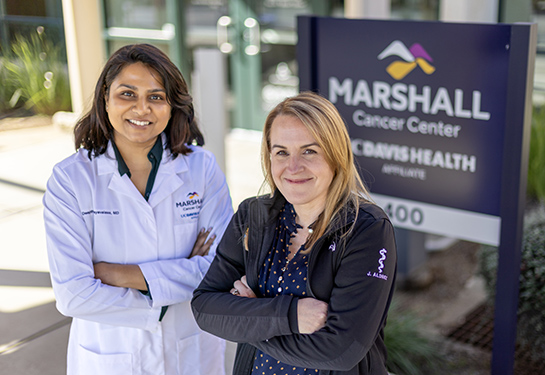
The cancer center is working in collaboration with UCSF, which is leading the ASPIRE study on the West Coast.
“We are looking at whether factors such as stress, environmental factors and access to care may be impacting their chances of having cancer,” saidMoon Chen, UC Davis principal investigator for ASPIRE.
Chen’s team launched its local recruitment campaign to the Vietnamese and Hmong communities in February at the Lunar New Year Tết Festival at Elk Grove Park and in May at the Sacramento Iu Mien 50thAnniversary celebration.
ASPIRE’s bilingual/bicultural Vietnamese staff set up an information booth to talk about the study with festival visitors. Eligible participants were asked if they would like to enroll in the study. To take part, participants must be:
Asian or Asian American
Age 40-75
Currently living in the United States or a U.S territory
Never diagnosed with cancer
Participants in the ASPIRE study will receive $25 for completing four surveys over 12 months. ASPIRE outreach staff will approach potential participants at gathering places for Asian Americans such as coffee shops, grocery stores and independent living units in the Sacramento area. Meanwhile, the Hmong Cultural Center of Butte County in Oroville will lead the effort to reach out to Hmong residents, who are more likely to live in rural areas and work in agriculture.
We are looking at whether factors such as stress, environmental factors and access to care may be impacting their chances of having cancer.” —Moon Chen, UC Davis principal investigator for ASPIRE
Rising up to meet a cancer research challenge
Asian Americans represent more than 30 ethnicities and speak more than 100 languages, yet research has historically combined them into a single category, masking critical differences. The ASPIRE study seeks to change that narrative.
ASPIRE is the first longitudinal cohort study focused on Asian Americans. The study plans to recruit 20,000 Asian Americans across six recruitment sites nationwide.
Unique cancers facing a diverse population
Despite perceptions that Asian Americans enjoy high socioeconomic status and low disease burden, recent studies show rising rates of several cancers within this population. For example, nonsmoking Asian American women have disproportionately high rates of lung cancer, a phenomenon that remains poorly understood.
“We also know that certain subgroups of Asian Americans have higher risks of certain cancers such as cancers of infectious origins, which may explain why there are higher rates of gastric, liver and cervical cancers,” Chen said. “There’s another concerning new trend showing increasing rates of breast cancer among Asian American women younger than 50.”
Chen added that these unexplained patterns underscore the need for a long‑term, large‑scale study like ASPIRE.
By assembling the most comprehensive dataset ever collected on Asian American cancer risk, ASPIRE intends to deliver insights that will reshape national cancer prevention strategies. It also aims to empower communities, improve screening guidelines and inform culturally relevant public health interventions.
UC Davis Comprehensive Cancer Center is the only National Cancer Institute-designated center serving the Central Valley and inland Northern California, a region of more than 6 million people. Its specialists provide compassionate, comprehensive care for more than 100,000 adults and children every year and access to more than 200 active clinical trials at any given time. Its innovative research program engages more than 240 scientists at UC Davis who work collaboratively to advance discovery of new tools to diagnose and treat cancer. Patients have access to leading-edge care, including immunotherapy and other targeted treatments. Its Office of Community Outreach and Engagement addresses disparities in cancer outcomes across diverse populations, and the cancer center provides comprehensive education and workforce development programs for the next generation of clinicians and scientists. For more information, visit cancer.ucdavis.edu.