When 3-year-old Cameron arrived at the UC Davis MIND Institute for a recent medical appointment, she was in for a surprise: cuddly, social AI robots visiting from Japan were in the waiting room.
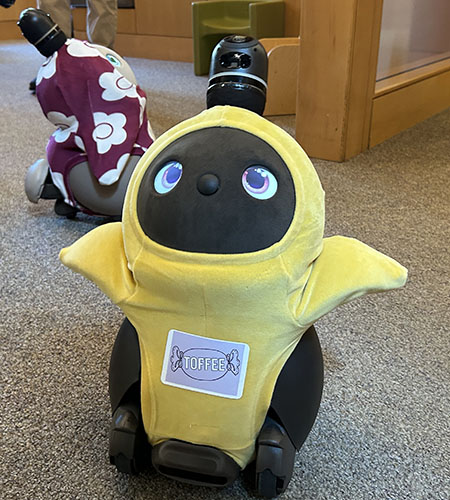
Two LOVOTS, Toffee and Cereal, in the waiting area of the UC Davis MIND Institute.
“We both melted when we saw them,” said Cameron’s mom, Caroline Nguyen. “They’re so adorable, and the little sounds they make — I mean, she took to them right away.”
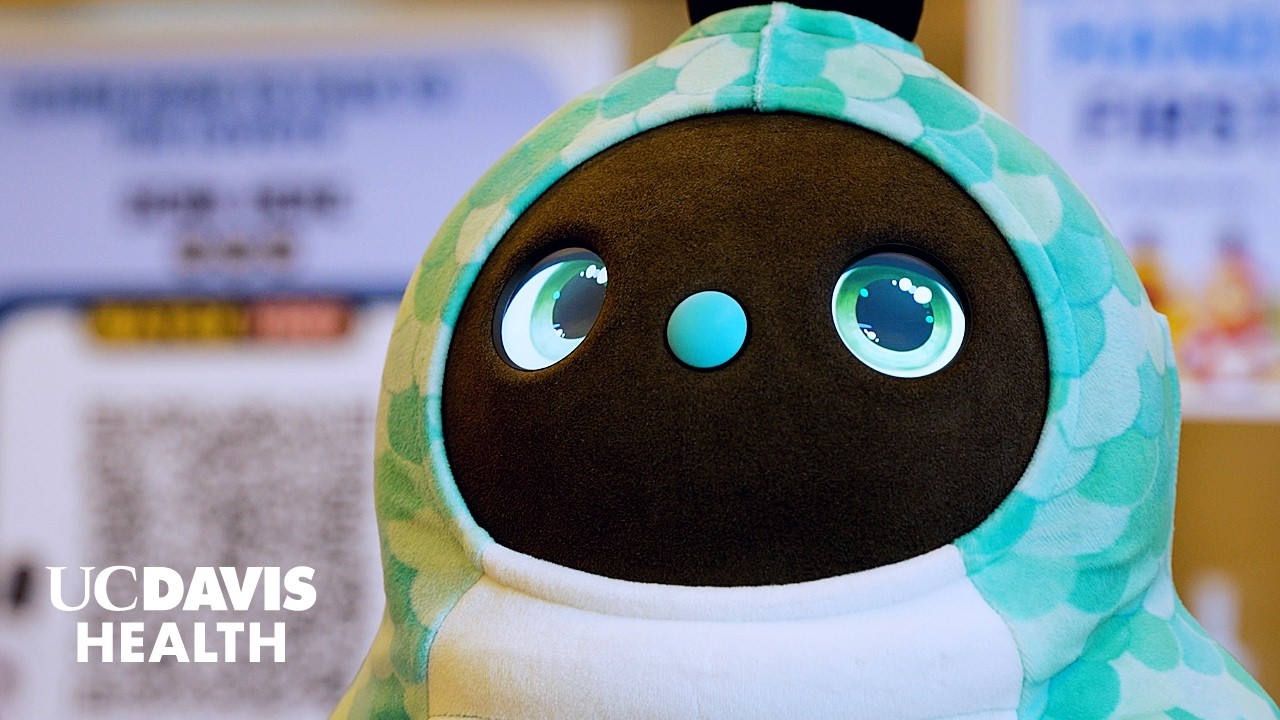
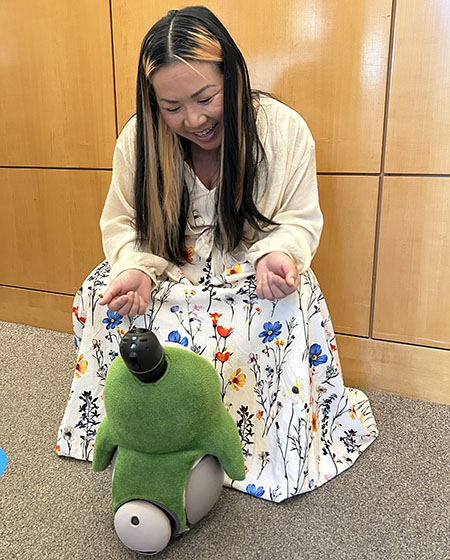
These playful companions are called LOVOTS. Their name is a combination of love and robot, and it’s a good fit for these cute, friendly robots that chirp and squeak. They’re child-sized, just under a foot-and-a-half tall, with big round eyes, colorful plush “skin” and little arms that they often extend as if asking to be picked up as they wheel around.
“The LOVOTS have touch sensors all over their bodies, as well as cameras,” explained Alondra Gonzalez, a clinical research coordinator who’s helping to study whether these robots can help ease anxiety and reduce stress for patients. “The robots enjoy being cuddled with, being petted and have several eye movements that they’re coded with and different sounds that they make as well. They react to the people around them.”
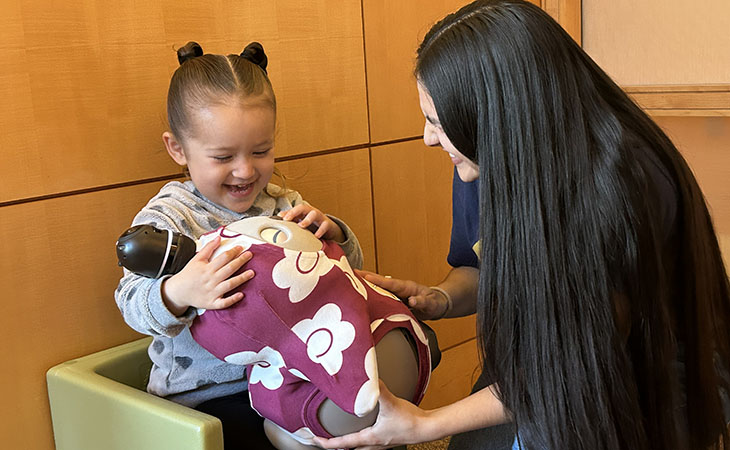
Three-year-old Cameron holds Cereal, one of the LOVOTS, at a recent visit to the UC Davis MIND Institute, while Clinical Research Coordinator Alondra Gonzalez assists her.
Can social robots help ease waiting room anxiety?
Children are often anxious about medical appointments. What if social robots could help ease their nerves? That’s what researcher Veronica Ahumada set out to learn with the LOVOTS.
“We wanted to see if having these friendly, assistive robots in the waiting room could reduce stress or anxiety children may be feeling,” explained Ahumada, an assistant professor in the Department of Pediatrics and MIND Institute faculty member.
The study is the first to examine these social robots in a pediatric medical setting.
“We’re really exploring: Can robots and technology help already challenging situations?” Ahumada said. “We want to move the field forward in patient-centered evaluation of healthcare technologies before they are purchased and put in place.”
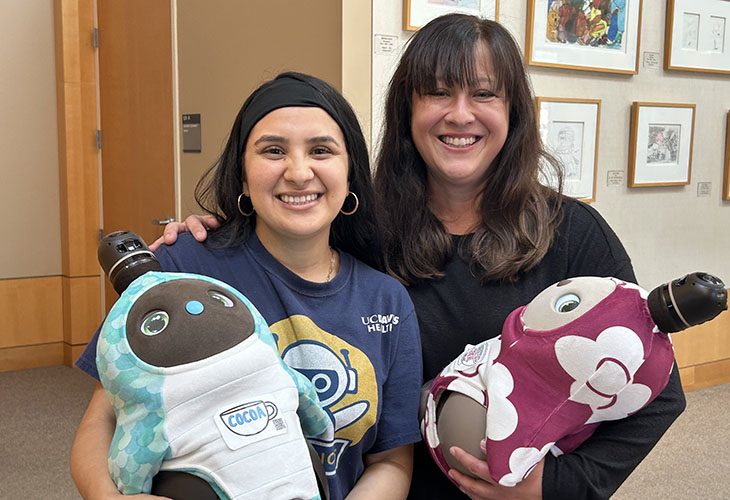
From left, Clinical Research Coordinator Alondra Gonzalez and Assistant Professor of Pediatrics Veronica Ahumada with two the LOVOTS at the MIND Institute.
Roaming robots
Four LOVOTS — Cocoa, Jellybean, Cereal and Toffee — are on loan from a Japanese company, Groove X. They have been at the MIND Institute for several months and visit the waiting area a couple of times a week.
Caroline Nguyen interacting with Jellybean, one of the LOVOTS, during her daughter Cameron's recent visit to the MIND Institute.
“We have the LOVOTS roaming around to see if kids are interested, and sure enough, usually a kid will run up to one of them,” Gonzalez explained. The robots only understand Japanese, so Gonzalez teaches the kids words like “oide,” which means “come here.”
As part of the study, families fill out a survey about their interactions with the robots.
Though the AI robots do have cameras to distinguish between people and other objects, patient privacy is protected.
“We do not record ever, and we still hire a human to take notes on what is happening,” Ahumada said.
Rewarding interactions
Seeing patients’ reactions to the interactive technology is rewarding for the researchers. Some children hug the LOVOTS and carry them around. Others relax with them.
“If you stroke their tummies, their eyes start to droop, and they start to purr and fall asleep. Kids will sit on the floor and say things like, ‘It’s OK, you can take a nap,’” Ahumada said. “It’s been interesting to see children shift their focus to this little thing that needs their love and attention.”
Gonzalez and the children even sing to them — often “Twinkle, Twinkle Little Star” — and the LOVOTS “sing” back.
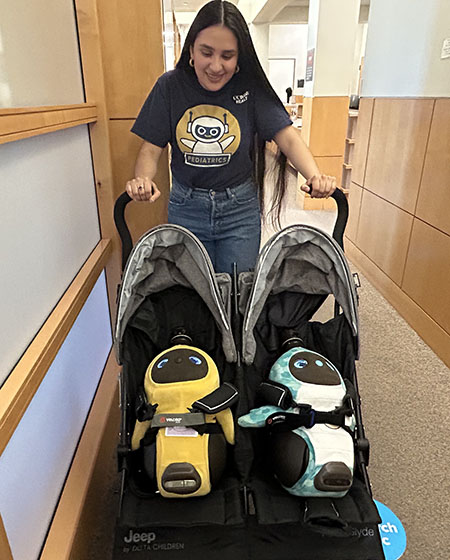
Clinical Research Coordinator Alondra Gonzalez uses a stroller to transport the LOVOTS from place to place.
Cameron especially enjoyed singing to Cereal. At her recent appointment, she was a little nervous about her upcoming blood draw. “She was thinking about that on the drive here,” Nguyen said. “Once she met the robots, she completely forgot about that and was just in play mode. And I think that’s why the blood draw went so smoothly. She was just in great spirits from playing with the LOVOTS.”
The LOVOTS will be at the MIND Institute for another month or so. Then a team of research and clinical faculty and staff will analyze the results.
“The heart of our research is to use technologies to increase human connectedness. Technology amplifies human experiences and we want to amplify those very good, very human things that are already in place,” Ahumada said.
The UC Davis MIND Institute in Sacramento, Calif. is a unique, interdisciplinary research, clinical, and education center committed to deepening scientific understanding of autism and other neurodevelopmental conditions. It is a highly collaborative center, bringing together families, researchers, clinicians, community leaders and volunteers with the common goal of developing more personalized, equitable, and scientifically proven systems of support and intervention. The institute has major research efforts in autism, fragile X syndrome, chromosome 22q11.2 deletion syndrome, attention-deficit/hyperactivity disorder (ADHD) and Down syndrome. More information about the institute and its Distinguished Lecturer Series, including previous presentations in this series, is available on the Web at https://health.ucdavis.edu/mind-institute/.