Robotic-assisted reverse shoulder replacement gives patient back his mobility
By Jen DeMoss
Mariano Menendez is one of only a few surgeons offering the procedure, which ensures precise implant placement
(SACRAMENTO)
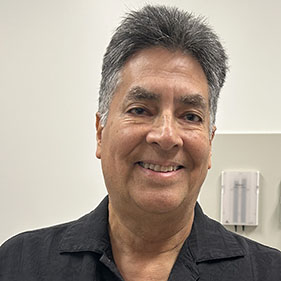
Stephen Mora loved to lift weights with his son, Lorenzo, who lives just a mile from their family home in Sacramento. In the past, they held weekly lifting sessions to hang out and talk about life.
But weightlifting fell to the wayside when Mora, age 68, started experiencing arthritis pain in his right shoulder. It wasn’t the only thing he had to give up. He eventually stopped traveling with his wife, Stina, and began avoiding other hobbies like yardwork, hiking, playing guitar and cooking.
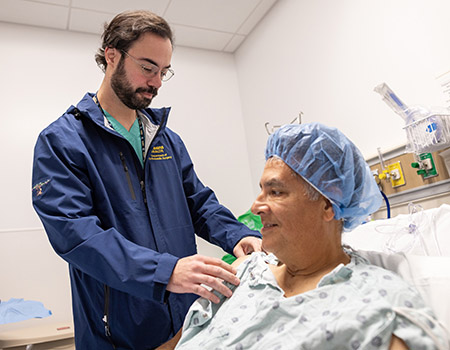
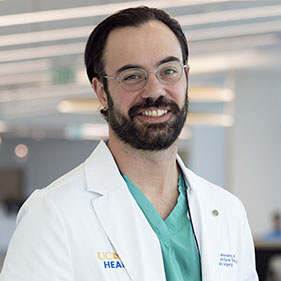
Orthopaedic surgeon Mariano Menendez examines Stephen Mora prior to his shoulder replacement surgery.
For about seven years, he tried non-surgical treatments, including physical therapy and cortisone injections. But it wasn’t enough and he slowly lost the ability to perform his favorite activities.
“I was in constant pain with bone rubbing against bone. I couldn’t sleep or really do anything. That’s when I decided to seek out surgical options,” Mora said.
Mora asked his primary care physician at UC Davis Health for a referral to an orthopaedic surgeon from the Sports Medicine Department. In November 2025, he consulted with Assistant Professor Mariano Menendez about a potential shoulder surgery.
Mora decided on a robotic-assisted reverse shoulder replacement.
A robotic-assisted procedure
At UC Davis Health’s new 48X Surgery Complex, Menendez uses the Stryker Mako robotic arm to assist in reverse shoulder replacements. He is among a small group of surgeons in the country qualified to operate the Mako robot for shoulder replacements, and the only one in the Greater Sacramento region. Mako is also used for knee and hip replacements.
Robotic-assisted shoulder replacement surgery helps ensure precise placement of components.
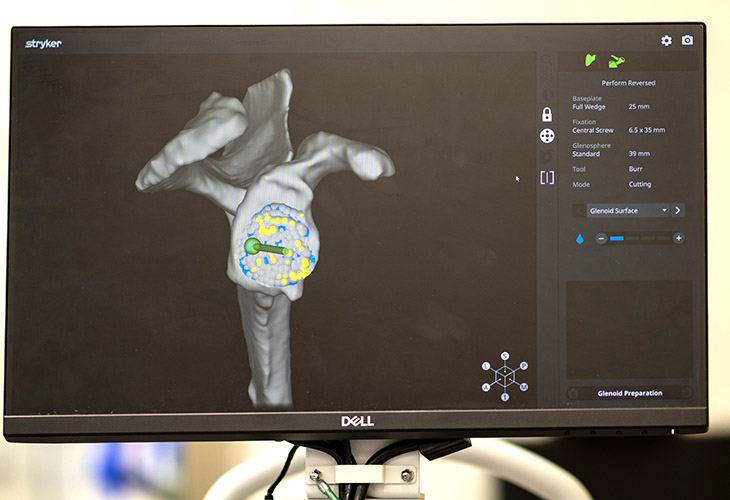
In a reverse shoulder replacement, the joint’s socket and ball are essentially flipped. For Mora’s surgery, Menendez used the robotic arm with real-time guidance on a monitor to prepare the socket side of the joint and place the implants exactly as planned before surgery.
“Reverse shoulder replacements have become the most popular form of shoulder replacement in the last 10 years,” Menendez explained. “By changing the shoulder’s mechanics, patients can raise their arms again without relying on the rotator cuff, which is oftentimes torn.”
Patients with severe arthritis, significant rotator cuff tears, shoulder fractures and chronic shoulder deformities may be good candidates for reverse shoulder replacement surgery.
Menendez explained that using a robotic arm helps guide bone preparation, drilling and implant placement in an area where there is little margin for error.
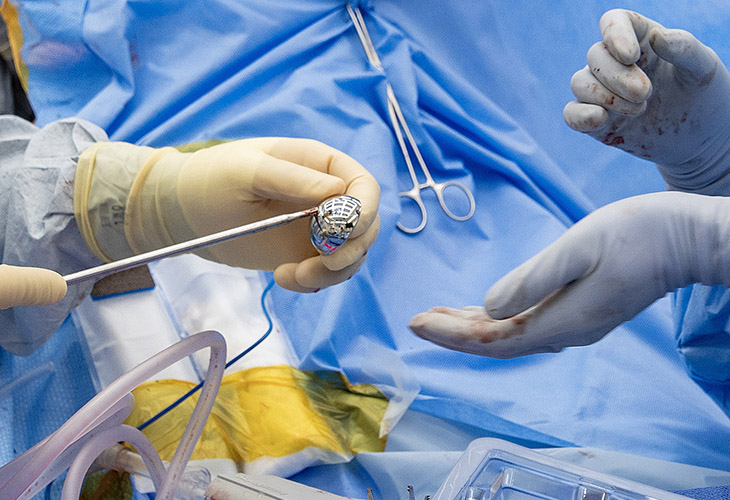
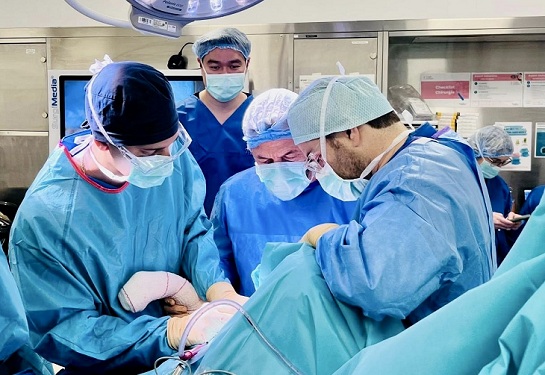
Surgeon Mariano Menendez and the surgical team prepare the components during Mora's shoulder replacement.
“Even shaping the bone’s surface a few degrees off can take things in the wrong direction,” Menendez said. “The robotic arm eliminates human variability.”
Menendez thinks it’s possible that more precise placement may result in a longer life for shoulder implants, though more research is needed.
“I always tell patients, if my mom needed a shoulder replacement, it would be robotic assisted. I truly believe in the technology,” Menendez said.
UC Davis on the whole has always been wonderful. And Dr. Menendez is so positive and has this great bedside manner. I feel like I’ll be able to attack life better than before.”—Stephen Mora, shoulder replacement patient
Mora’s surgery and recovery
After his robotic-assisted shoulder replacement in December, Mora spent the first two weeks with his right arm in a sling, then began trying out simple movements.
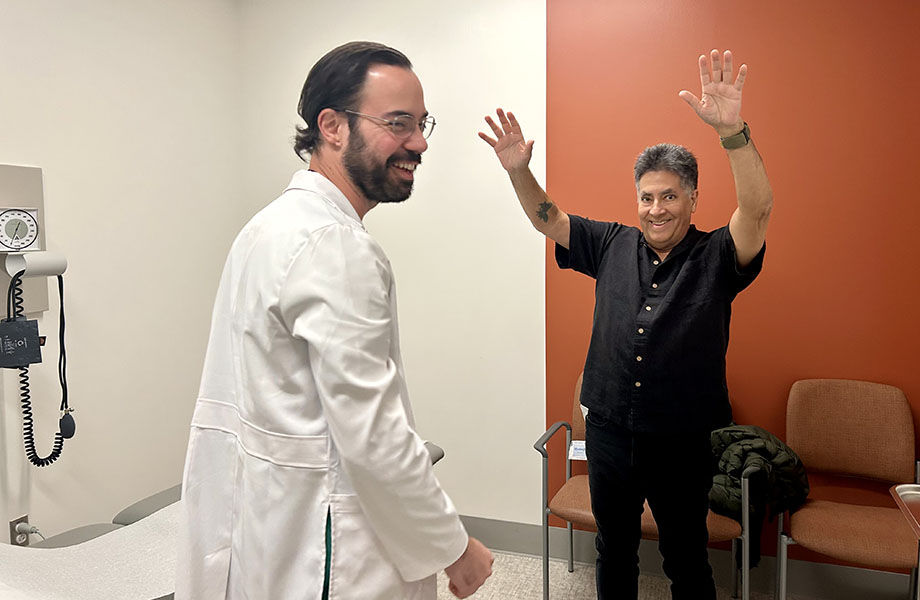
Stephen Mora demonstrates how high he can lift his arms in a post-surgery appointment at UC Davis Health's Folsom Center for Health with surgeon Mariano Menendez.
After four weeks, he was able to sneak in a little light yardwork. He’ll soon begin physical therapy to expand his range of motion and regain strength, and credits Menendez with helping him gain the confidence to explore shoulder movement.
“UC Davis on the whole has always been wonderful,” Mora said. “And Dr. Menendez is so positive and has this great bedside manner. I feel like I’ll be able to attack life better than before.”
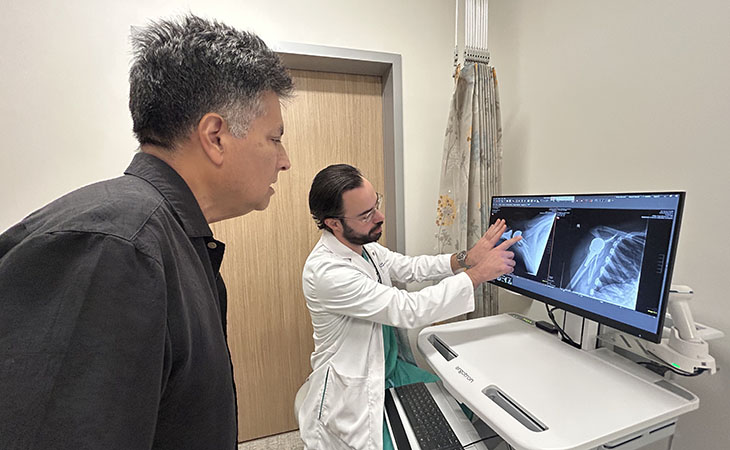
Surgeon Mariano Menendez shows patient Stephen Mora his post-operative x-rays after a robotic-assisted shoulder replacement surgery.
Menendez noted that shoulder replacements can give patients a new lease on life.
I always tell patients, if my mom needed a shoulder replacement, it would be robotic assisted. I truly believe in the technology,”—Mariano Menendez, orthopaedic surgeon
“In general, it’s a great operation for patients with significant pain that limits their activity and keeps them awake at night,” Menendez said. “If they’ve done physical therapy and had injections, and nothing is working, it’s excellent for getting them back to the things they want to do.”
Mora is already dreaming of taking Tai Chi lessons, getting back on the road with Stina, and resuming weightlifting with Lorenzo.
“If someone is suffering like I was and they’ve exhausted all their options, I absolutely encourage them to seek out surgery,” Mora said. “It’s possible to get back in the game.”