
Clinical ScienceMarch 19, 2026
Mark Rosenblatt: Exploring new pathways in corneal nerve regeneration
How laboratory discoveries translate into improved patient care
(SACRAMENTO)
Mark Rosenblatt approaches biomedical research with a straightforward premise: Clinical care and laboratory discovery are mutually interconnected principles.
As the vice chancellor of human health sciences at UC Davis Health, he is in a unique position. He can lead both his own research and help to make it possible for thousands of other researchers to make advancements in medical science, as well. Rosenblatt says breakthroughs in patient treatment often originate in basic science laboratories, but observations from time spent in the clinic also generate new scientific questions that guide future investigations.
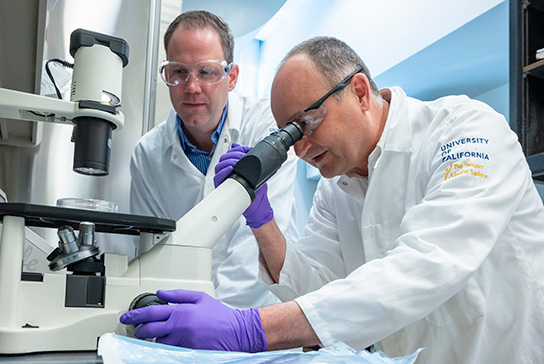
Rosenblatt is an internationally renowned clinician-scientist. His research lab focuses on corneal peripheral nerve regeneration following injury and the development of nanoengineered biomaterials for stem cell delivery to the ocular surface.
Translational science
In a recent interview, Rosenblatt explained that translational science operates as a bidirectional process. Discoveries made at the laboratory bench may identify molecular pathways relevant to disease. Those findings can then be tested in clinical settings.
At the same time, tissue samples and clinical patterns observed in patients can prompt laboratory-based mechanistic studies.
“Strong academic medical centers move in both directions,” he said. “You examine mechanisms in the lab, assess whether they matter clinically, and then refine your understanding by going back to the laboratory with new questions.”
Corneal nerve regeneration
As an ophthalmologist, Rosenblatt concentrates on the cornea, the transparent outer surface of the eye. The cornea is among the most densely innervated tissues in the human body. This enables rapid detection of injury or irritation and the triggering of protective responses such as blinking and tearing. Damage from trauma, infection, surgery or chronic disease can impair sensation and healing.
Rosenblatt’s lab investigates how damaged corneal nerves regenerate and how functional recovery can be optimized. The research examines both anatomical regrowth and restoration of balanced nerve signaling that minimizes chronic pain while preserving protective sensation.
One focus of the laboratory involves ion channels — molecular sensors that allow nerves to detect temperature, mechanical force and chemical stimuli. Similar ion channels elsewhere in the body have been recognized for their role in pain signaling. By identifying which channels are active in corneal nerves, researchers can explore strategies to modulate abnormal signaling.
The lab also evaluates growth factors that promote nerve regeneration. Molecules such as nerve growth factor and related proteins influence how peripheral nerves extend and reconnect with their targets. Rosenblatt emphasized that effective regeneration requires more than structural repair; functional signaling must also be restored.
VEGF-B holds promise
A recent line of inquiry centers on vascular endothelial growth factor B (VEGF-B). While VEGF-A is widely known for stimulating blood vessel growth, such vascularization is undesirable in the cornea, where transparency is critical for vision. VEGF-B appears to support nerve regeneration without inducing significant blood vessel formation.
In research published in the Proceedings of the National Academy of Sciences, Rosenblatt and colleagues assessed whether VEGF-B could serve as a selective nerve growth factor in the cornea.
The findings contribute to broader understanding of how growth factors may be applied safely in tissues where vascular growth must be limited.
The laboratory’s work has received support from the National Eye Institute within the National Institutes of Health and from the U.S. Department of Defense. Eye injuries are common in both civilian and military settings, particularly in the context of blast exposure or penetrating trauma.
Research that improves corneal nerve recovery has implications for vision preservation and the quality of life for patients, Rosenblatt noted.
Interdisciplinary collaborations
Rosenblatt established his laboratory in 2005 and has sustained a continuous research enterprise for 21 years. His current team includes seven researchers, with plans for some members to relocate to UC Davis Health. He is evaluating laboratory space options that would allow collaboration across both the Davis campus and UC Davis Health’s facilities in Sacramento.
Rosenblatt cited the university’s strengths in neuroscience as an important factor in that decision. Collaboration with investigators studying neuropathic pain and peripheral nerve biology may enhance his lab’s work on corneal sensation and regeneration.
“Interdisciplinary collaboration is essential,” Rosenblatt said. “Vision science intersects with neuroscience, immunology, bioengineering and clinical medicine. Bringing those perspectives together strengthens the research.”
When asked about the university’s vision research, Rosenblatt noted that the institution has an acclaimed base of experienced clinicians, researchers and recent recruits. He also emphasized the importance of continuing to build programs that integrate clinical insight with basic science expertise.
Toward this, UC Davis Health includes the Department of Ophthalmology and Vision Science at the UC Davis School of Medicine and the UC Davis Health Eye Center. The Eye Center offers a full range of ophthalmic services for adults and children in the Sacramento region. The Ernest E. Tschannen Eye Institute, which opened in 2022, aims to accelerate the Eye Center’s achievements in leading-edge vision research and clinical applications.
Rosenblatt recently visited Aggie Square and saw firsthand the innovation hub’s bountiful lab space. Aggie Square is a major innovation district developed by UC Davis on its Sacramento campus near UC Davis Health. The project brings together university researchers, private companies, entrepreneurs, students, and community partners in a shared space designed to accelerate collaboration and discovery.
“The research programs there are wonderful in the neurosciences, among others. So, maybe there’s an opportunity to have both worlds kind of straddle the cause” between his research lab’s work and the neurosciences, he said.
At Aggie Square, about 350 School of Medicine scientists and affiliated centers will conduct collaborative studies on public health, health policy, and emerging technologies in neurosciences, cancer, surgical biomedical engineering and musculoskeletal research.
Mosaic of mentors
Throughout his career, Rosenblatt said that he was influenced by a “mosaic of mentors” across multiple institutions. This included clinician-scientists he encountered during his MD-PhD training at the University of Miami’s Bascom Palmer Eye Institute and later colleagues at the Massachusetts Eye and Ear Infirmary/Harvard Medical School, where he completed his ophthalmology residency and combined clinical/research fellowship in corneal disease.
He described the mentorship journey as cumulative, with different people offering scientific, clinical and professional guidance to him.
Looking ahead, Rosenblatt intends to maintain a focused research agenda while balancing administrative responsibilities.
His primary research objective remains consistent: to clarify the biological mechanisms underlying corneal nerve injury and regeneration and to translate those findings into improved patient care.
“The questions evolve as new technologies and collaborations emerge,” he said. “But the goal is steady — to understand mechanisms carefully and apply that knowledge in ways that improve outcomes for patients.”
More about Rosenblatt
Rosenblatt’s scholarship includes more than 225 original manuscripts, review articles, book chapters and abstracts. Rosenblatt’s academic career began at UC Davis Health in 2005 as an assistant professor of ophthalmology and vision science. In January of 2026, he returned to UC Davis Health as its highest-ranking executive, leading an academic medical system that includes two schools of health and three hospitals, all of which are nationally ranked as leaders in their fields.
Two decades ago, Rosenblatt divided his responsibilities between laboratory research on the Davis campus and medical education and clinical care in Sacramento. Nearly two decades later, he returned to UC Davis Health as its senior leader, and a similarly divided schedule, overseeing the health system and continuing to guide a very active research laboratory.