Air Force Surgeon General’s visit highlights military-civilian partnership
By Clifton B. Parker
(SACRAMENTO)
Senior leaders and their teams from the U.S. Air Force visited the Sacramento campus on April 23 to gain a closer look at their military-civilian partnership with UC Davis Health on medical readiness, trauma care and physician training.
Lt. Gen. John J. DeGoes, Surgeon General and Commander of Air Force Medical Command, andBrig. Gen. Leigh A. Swanson, Air Mobility Command Surgeon and Chief of the Air Force Medical Corps, toured the UC Davis Medical Center and met with clinical and academic leaders to better understand the 30-year collaboration between UC Davis Health andDavid Grant USAF Medical Centerat Travis Air Force Base.
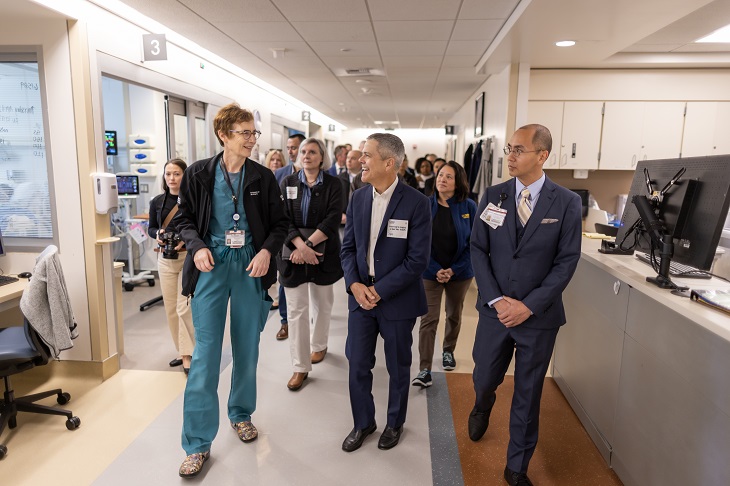
Lt. Gen. John J. DeGoes, Surgeon General and Commander of Air Force Medical Command, and Brig. Gen. Leigh A. Swanson, Air Mobility Command Surgeon and Chief of the Air Force Medical Corps, toured the Emergency Department on April 23.
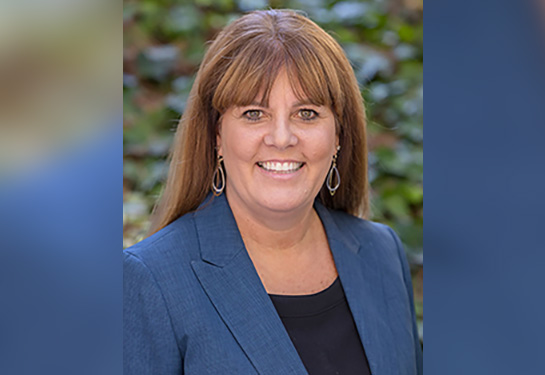
Rachel A. Hight, a retired U.S. Air Force colonel and UC Davis Health associate professor of surgery, is the liaison for the partnership, which has become a model for integrating military and civilian expertise to improve patient care and readiness for complex medical scenarios on the battlefield.
Hight described it as a “true partnership” that represents the best of what can happen when missions in health care and the military are aligned. Together, she noted, the participants are building a platform that strengthens clinical excellence while preparing military physicians and care teams to respond anywhere, at any time, in the world.
One key phrase, she explained, is, “We answer the call, so others may prevail. Ready for anything, anywhere.”
Hight said that UC Davis Health was a perfect host for such a relationship, due to its large 33-county catchment in Northern California and itshigh-national rankingsin a number of specialties and distinctions. For training purposes, among other resources, the health system also includes a Simulation Center, a Level 1 Comprehensive Education facility. In 2030, when the California Tower is slated to open, that facility will include an entire fifth floor dedicated to surgical education and simulations.
High-acuity, high-volume care
The Air Force delegation began their visit with a morning tour of the UC Davis Medical Center, including the Emergency Department (ED) and the Burn Intensive Care Unit (ICU) – two of the health system’s most critical care environments.
Through the partnership, these clinical areas provide military physicians, nurses and medics with exposure to high-acuity, high-volume trauma cases that are essential for maintaining troop deployment readiness.
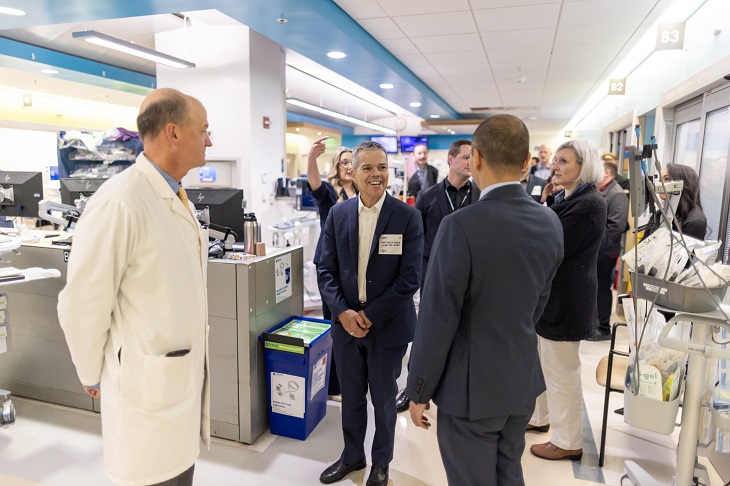
Senior Air Force medical leaders interact with UC Davis Health staff during their visit regarding the military-civilian partnership.
Active-duty personnel train alongside UC Davis Health teams, gaining hands-on experience in managing complex injuries, including burns, multi-system trauma and emergency surgical care.
For Air Force leaders, the visit offered a firsthand view of how these clinical experiences translate into operational readiness.
The collaboration has already drawn national attention. According to Hight, the Air Force Surgeon General’s office recently sought insight into the program after observing exceptional readiness among medics deployed from David Grant. Leaders attributed that performance, in large part, to training received through the UC Davis Health partnership.
She added that one key achievement that arose years ago from these efforts was the introduction of Resuscitative endovascular balloon occlusion of the aorta (REBOA), a minimally-invasive procedure that is now widely-used during resuscitations of critically-injured trauma patients in military conflicts. And these injuries can be quite more complex.
“War wounds are often more traumatic than normal civilian wounds,” Hight said.
Building readiness through partnership
David Grant USAF Medical Center, the Air Force’s largest medical center at nearby Travis Air Force Base, serves more than 500,000 beneficiaries across eight western states and operates the largest graduate medical education program in the Air Force.
Its longstanding relationship with UC Davis Health allows military trainees to rotate through a high-volume academic medical center, expanding their clinical exposure and sharpening critical skills across multiple specialties, including general surgery, emergency medicine, orthopedics and internal medicine. It also supports advanced training programs for physician assistants, nurse anesthetists and other allied health professionals.
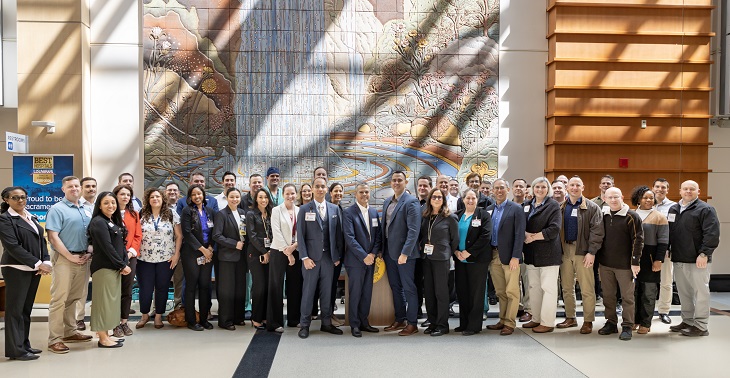
Air Force and UC Davis Health medical leaders and teams who are involved in the military-civilian partnership on medical readiness, trauma care and physician training.
Together, UC Davis Health and David Grant are addressing a shared goal – ensuring that military clinicians are prepared to deliver high-quality care in both routine and battlefield environments.
Following the clinical tour, the delegation joined UC Davis Health and Air Force leaders for a series of presentations outlining the scope and impact of the Military-Civilian Partnership.
Sessions highlighted key areas of collaboration, including graduate medical education, trauma training programs, research initiatives and global surgical education efforts.
Speakers emphasized how the partnership not only enhances clinical readiness but also drives innovation, helping to shape the future of care delivery in extreme environments. By working within a large academic health system, trainees encounter a breadth and volume of cases that would be difficult to replicate in a military-only setting.
A shared mission
For UC Davis Health, the collaboration aligns with its broader mission to advance health through clinical care, education and research. For the Air Force, it ensures that medical teams are equipped to meet the demands of modern military operations.
This teamwork is not only about readiness – preparing medics in the military – but also about excellence in patient care, Hight said. When military and civilian teams come together, they elevate the standard of care for all patients.
The April 23 visit reinforced the strength of that association with UC Davis Health and the opportunity to expand its impact.
“Everyone here has been enriched by our partnership,” High said. “There is a sense of pride, like the camaraderie you get in the military.”