Spine surgery with custom lumbar implants helps woman move again without pain
By Emily Halnon
UC Davis surgeon uses custom lumbar implants to get former sports columnist Ailene Voisin back to her active lifestyle
(SACRAMENTO)
For most of her life, Ailene Voisin was always on the move: swimming, skiing, running, walking and traveling every chance she got. She loved sports. In fact, Voisin was a sports columnist forThe Sacramento Beefor more than 20 years. But in her late 60s, a worsening spinal condition left her unable to go anywhere without a walking stick. She went from exercising nearly every day of the week to being unable to move without severe discomfort. At times, she struggled to walk.
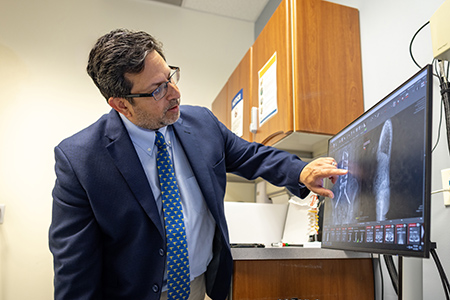
Safdar Khan points to recent x-rays of Voisin’s back that show the locations of the two custom lumbar implants he surgically placed in her lower spine.
Now 71, Voisin tried several interventions to ease her symptoms, but nothing offered a lasting solution. She was in constant pain and relied on ibuprofen to get through her days.
Voisin was losing hope that she’d ever get her active life back untilSafdar Khan, an orthopaedic surgeon atUC Davis Health, recommended an innovative new approach to spinal surgery that could likely eliminate most of her pain and get her moving again.
A game-changing option for spinal fusion surgery
Khan suggested that Voisin consider custom lumbar implants through aspinal fusion surgery. The implants are designed to fit into the low back like a missing puzzle piece to address a patient’s specific anatomical needs. In Voisin’s case, her issues stemmed from scoliosis along with severe stenosis, a degenerative condition that narrows spacing in the spine and puts pressure on the nerves and spinal cord.
Through imaging, Khan could see that her spine was rotated and collapsing. It was only getting worse, which was fueling Voisin’s pain and mobility challenges.
Khan explained that Voisin needed her vertebrae to be knitted together to create more stability and more space between them. This would relieve pressure from nerves in her spinal column.
“Dr. Khan showed me how my vertebrae were touching because the spacing in my spine had degenerated so drastically,” she said. “And he showed me where he wanted to place custom spacers and why he wanted to make them an exact match for my anatomy. It made perfect sense to me. Why wouldn’t you do that?”
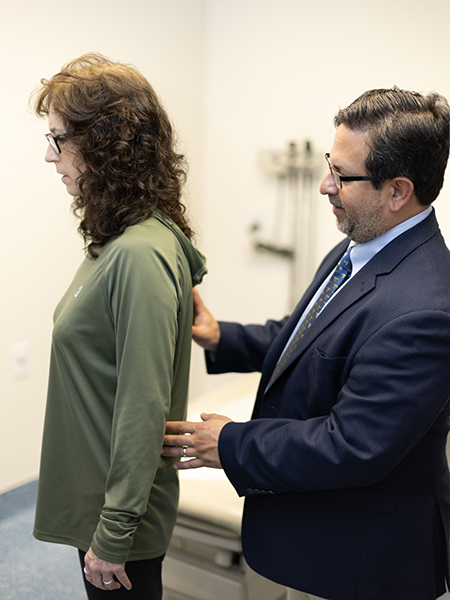
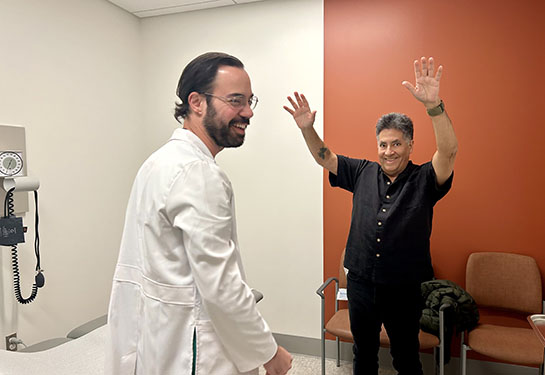
Safdar Khan examines Ailene Voisin’s back at a recent post-operation visit.
The many benefits of a patient-specific approach
Surgeons perform spinal fusion surgeries by using screws, rods, and a metal cage to create space for the nerve passageway and hold the spine together. But the implants used in these surgeries for the last 15 years have been off-the-shelf devices that are only available in limited sizes, Khan said. They’re essentially a one-size-fits-all model, he explained, and spinal anatomy is obviously not a universally uniform structure.
“With such variable anatomy and spinal structures across patients, we’re asking why we’ve been using off-the-shelf implants that aren’t configured for that high level of variance?” said Khan, who is with the UC Davis HealthSpine Centerand is the vice chair for surgical innovation. “The concept behind patient-specific, inner-body solutions is that we want to create an implant that offers a high-level of precision and matches the patient’s contours and anatomy.”
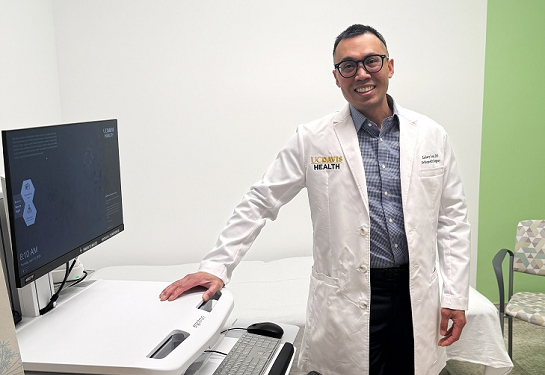
Patient-specific implants are a relatively new technology in the world of spinal surgery — and one that’s shown a lot of promise, Khan said. That’s why Khan and orthopaedic surgeon colleagueHai Leihave seized the opportunity to use this leading-edge technique at UC Davis Health. They want to offer patients like Voisin a more tailored approach to spinal surgery.
Improving health outcomes for patients
“Ailene’s anatomical issues made her an ideal candidate for this personalized implant, because we felt that by contouring her implant to match her spine, we could correct her spinal deformity and also avoid having to do bigger surgeries that would require a more aggressive approach,” Khan explained.
Khan worked with an external manufacturer to design and produce implants for Voisin. Through surgery, he released her spine from her abdomen, cleaned out soft tissue and discs between her rotated bones, and then placed the patient-specific implant into her lumbar spine to improve her alignment. He also placed screws and rods through the back of her spine to improve her stability.
Another major benefit of custom implants is that the surgeon is able to increase the amount of surface area that makes contact with the patient’s spinal structure. This increases stability when a surgeon knits the bones together and it improves the chances of a successful operation.
Off-the-shelf implants don’t always contour to a patient’s anatomy, which increases the chances of a patient needing a revision operation because things don’t heal as well as they could, Khan said. Revision operations are one of the most common complications of spinal fusion surgery, he explained, pointing to one study that found20% of spinal deformity patients needed revision surgeryto correct or improve complications.
The future of personalized medicine at UC Davis Health
Custom implants aren’t restricted to the lumbar region of the spine. Khan’s group at UC Davis Health is exploring a variety of patient-specific implants to address other issues, including implants for the neck and front of the spine. The greatest challenge is the cost, said Khan. But he’s hopeful that as research continues and more data are collected, both at UC Davis and across the nation, patient-specific implants will become more accessible.
“I think that patient-specific implants will be the future, especially for complex spinal surgery, where a customized implant is going to increase our odds of a successful operation,” he said. “I’m thrilled we’re able to offer this technology to some of our patients at UC Davis Health so we can build upon our personalized medicine program for orthopaedics.”
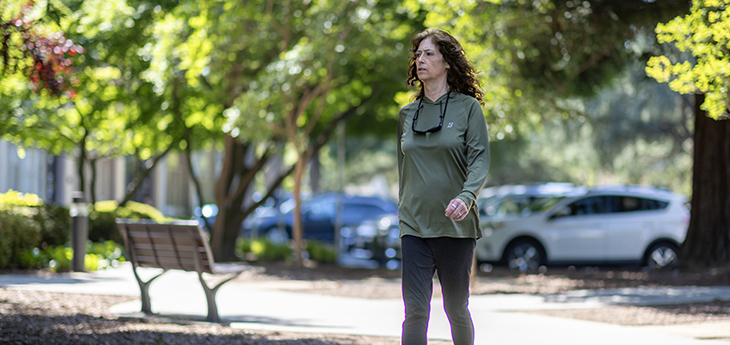
Patient-specific implants certainly gave Voisin a more promising future, she said. She’s back to swimming and walking nearly every day of the week and her old walker is collecting dust in the corner.
“This surgery made such a big difference and created an immeasurable improvement to my quality of life,” she said. “My brother just reminded me, ‘You were always complaining about your pain. And now I don’t hear you ever talk about your pain at all.’”
For more information on custom spine implants or to make an appointment with theUC Davis Health Spine Center,call 916 734-7463.