Kitten’s brain surgery at UC Davis could transform care for human patients
By Pamela Wu
A novel procedure to save a kitten highlights UC Davis’ unique partnership between human and animal health experts
(SACRAMENTO)
UC Davis’ unique integration of human and animal health expertise has given a fluffy, friendly kitten a chance at survival — and opened the door to ideas that could someday help human patients.
Hydrocephalus: a life-threatening diagnosis
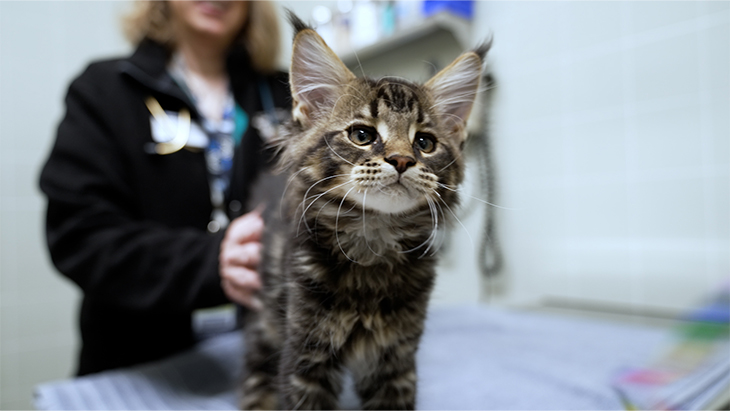
When Erin Cooper noticed herMaine Coonkitten Viggo had an oversized head, she never imagined it meant something serious. But an MRI revealedfeline hydrocephalus: a buildup of fluid inside the brain that is often fatal.
“These kittens, they don’t feel well,” saidKaren Vernau, veterinary neurologist at UC Davis. “They may circle, they can’t stand, and when it really gets terrible, their brain can herniate, and they pass away.”
Treatment options are rare and often fail. Most kittens with hydrocephalus are euthanized within months.
Pediatric neurosurgeon Cameron Sadegh leads a research team that designs cellular and genetic therapies to treat hydrocephalus.
“We’ve been using a technique forhuman hydrocephalusthat, although effective, hasn’t changed in about 70 years,” Sadegh said. “I think we can do better.”
Standard treatment for hydrocephalus uses a ventriculoperitoneal (VP) shunt to drain fluid from the brain to the abdomen. For tiny babies, surgeons use a ventriculosubgaleal (VSGS) shunt to divert fluid under the scalp. Another option, endoscopic third ventriculostomy (ETV), creates a natural drainage pathway without shunts, but often fails in the smallest patients.
Sadegh came up with a novel idea: combine ETV with VSGS. The VSGS would serve as a bridge while the young brain grows and adjusts. Once the brain matures, the drainage from the ETV should keep working on its own.
When Sadegh learned about Viggo's case, he saw a rare chance to work with his counterparts in veterinary medicine to save a cherished pet — and shape future treatment for humans.
We’ve been using a technique for human hydrocephalus that, although effective, hasn’t changed in about 70 years. I think we can do better.”—Cameron Sadegh, Pediatric Neurosurgeon
First-of-its-kind surgery
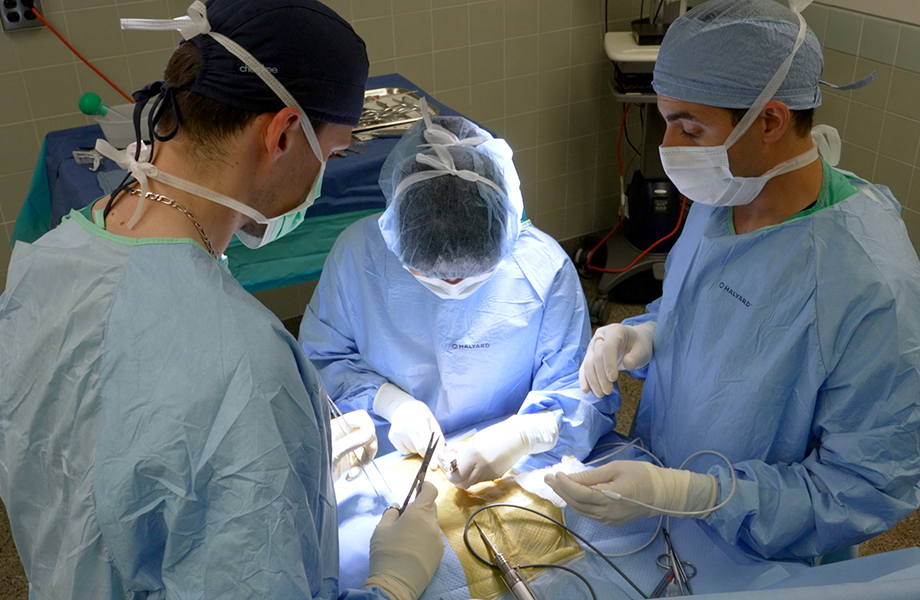
On surgery day last May, Sadegh joined veterinary neurosurgeonsJi-Hey LimandAdrien DupanloupatUC Davis Veterinary Teaching Hospital. With an endoscope, a tiny camera just one millimeter wide, they navigated Viggo’s brain to create a precise opening in the third ventricle. A small tube called a catheter then allowed fluid to disperse under the scalp.
“It was amazing,” Sadegh recalled. “We were looking at the fluid spaces in this sort of magical, underwater-type voyage. Then that moment when we got in for the first time and could see this big artery down in the brain stem pulsating right in front of us.”
The delicate procedure succeeded.
The life-saving surgery performed on Viggo, a Maine Coon kitten, is helping to inform pediatric neurosurgery research at UC Davis Children’s Hospital.
Hope for future patients
Months later, Viggo returned for an MRI. The images showed what Sadegh hoped to see: less fluid, thicker brain tissue and a catheter still in place.
Recovery wasn’t instant. Viggo needed to relearn some kitten behaviors. But six months later, owner Erin Cooper says he’s thriving: “He’s playing, grooming, eating. I feel like we have Viggo at 95 percent back.”
To Vernau, the outcome is remarkable. “This brings hope for kittens where we had no hope before,” she said.
For Sadegh and his research team in theBrain Fluids Lab, Viggo’s surgery offers a glimpse of what might be possible for human babies. “My hope is that we’ll get to try this several more times and see the longer-term outcomes,” he said. “Then — eventually — confidently provide that as a new option to some human patients.”
Another kitten has already had the same procedure, adding valuable knowledge for future research.
Cooper feels awed that Viggo’s surgery could someday transform care for the smallest and most vulnerable humans. “Him being a part of helping not only other animals, but humans and babies — it’s amazing.”
The novel procedure pediatric and veterinary neurosurgeons performed on Viggo could shape future treatment for humans.