For more than two decades, the popular speaker series has offered free presentations on research and clinical care for individuals with neurodevelopmental disabilities.
“It’s hard to pick a talk that I’m most excited about this year,” said the MIND Institute’s David Hessl, who directs the series and is a professor in the Department of Psychiatry and Behavioral Sciences. “What I enjoy most is the opportunity to step outside the intense focus on my own research and to stay connected with where our field is moving.”
It’s also a great occasion, Hessl noted, to engage with community members, patients and families, as each lecture is followed by a Q&A session with the speaker. “My favorite part of the events is facilitating the discussions after the lectures,” he said. “It is often surprising and eye-opening to hear what the audience has to say or ask about — things I would never think to ask!”
Staying connected with others and having the chance to interact directly is so important, and this is a great opportunity for an exchange of ideas between scientists and our community.” —David Hessl, professor, Department of Psychiatry and Behavioral Sciences
The series will include five in-person lectures between January and May. Topics featured will include advances in autism research, brain imaging and racial and ethnic disparities in care.
All lectures will be held at the UC Davis MIND Institute auditorium from 4:30-6 p.m. They are free and open to all. No registration is needed.
Distinguished Lecturer Series Lineup
Jan. 14: Andrea Chronis-Tuscano, University of Maryland Developing, Evaluating, and Implementing Interventions for Families of Youth with ADHD
Feb. 11: Sandy Magaña, University of Texas at Austin Addressing Racial and Ethnic Disparities in Care for Children with Intellectual and Developmental Disabilities
March 11: Matthew Mosconi, University of Kansas Identifying Subgroups of Autism Based on Family Traits
April 8: Damien Fair, University of Minnesota Liftoff: Neuropsychiatry with Functional MRI Comes of Age
May 13: Kelsey Martin, Simons Foundation The Evolving Landscape of Autism Research
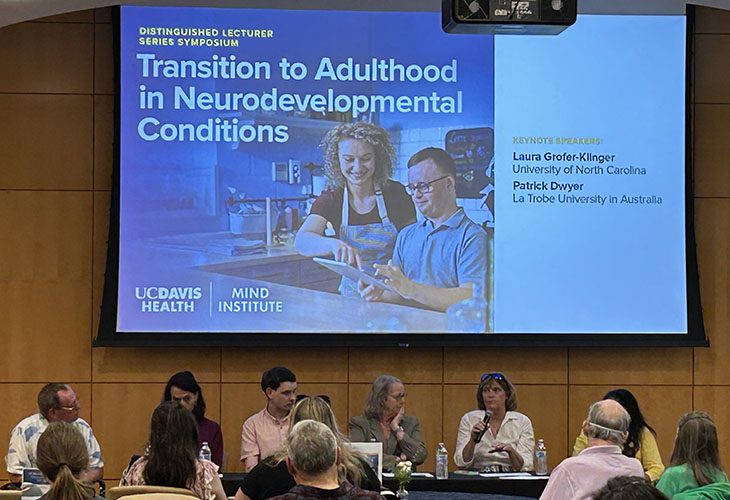
The 2025-2026 Distinguished Lecturer Series kicked off in October with a symposium focused on the transition to adulthood for individuals with neurodevelopmental conditions.
A focus on science and community connection
The 2025-2026 season’s events kicked off in October 2025 with a symposium on the transition to adulthood for individuals with autism and other neurodevelopmental disabilities. It featured two keynote speakers and a panel discussion focused on education and employment.
“The lecture series showcases strong science,” Hessl said. “Our society needs to be aware of this and know that we will continue to advocate and promote the sharing of quality research.” He emphasized the importance of public engagement and trust in research.
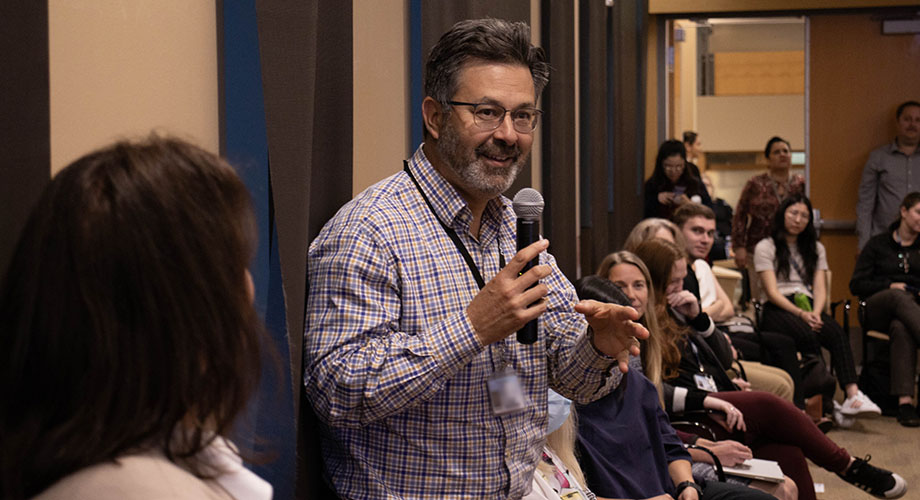
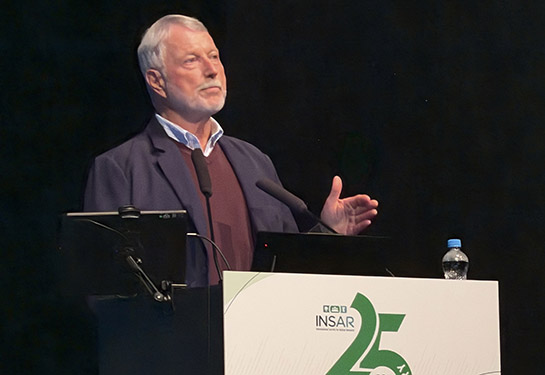
Professor David Hessl interacts with attendees at a previous Distinguished Lecturer Series presentation. He said facilitating the question and answer session after each lecture is his favorite part of the events.
The series is designed to engage a wide range of audiences including researchers, health care providers, community members, patients and families, among others. That reach, Hessl said, is a unique advantage of the talks — and the in-person format.
“Staying connected with others and having the chance to interact directly is so important, and this is a great opportunity for exchange of ideas between scientists and our community,” he added.
Event details
Where: All events are held at the UC Davis MIND Institute auditorium, 2825 50th St., Sacramento, CA
When: All lectures begin at 4:30 and run until 6 p.m. Light refreshments are offered at 4 p.m.
Events are free and open to all. No registration needed. Seating is first come, first served. Parking is available in the MIND Institute lot (Lot 25).
The UC Davis MIND Institute in Sacramento, Calif. is a unique, interdisciplinary research, clinical, and education center committed to deepening scientific understanding of autism and other neurodevelopmental conditions. It is a highly collaborative center, bringing together families, researchers, clinicians, community leaders and volunteers with the common goal of developing more personalized, equitable, and scientifically proven systems of support and intervention. The institute has major research efforts in autism, fragile X syndrome, chromosome 22q11.2 deletion syndrome, attention-deficit/hyperactivity disorder (ADHD) and Down syndrome. More information about the institute and its Distinguished Lecturer Series, including previous presentations in this series, is available on the Web at https://health.ucdavis.edu/mind-institute/.