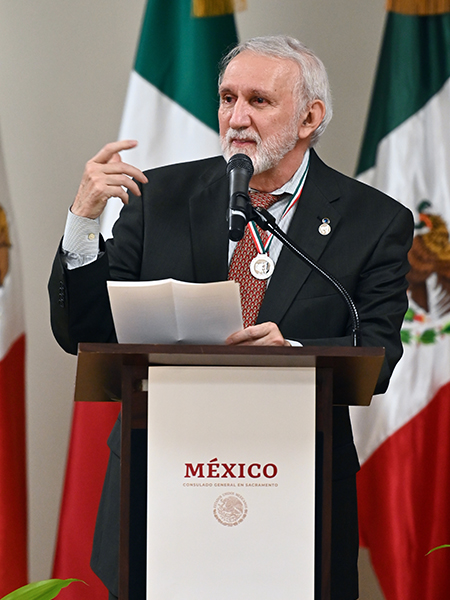
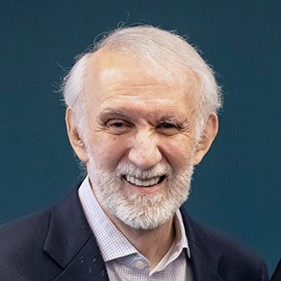
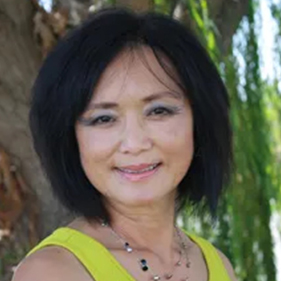
Center for Reducing Health Disparities Director Sergio Aguilar-Gaxiola speaks at the Consulate of Mexico in Sacramento after receiving the Ohtli award in 2020. The award is one of the highest honors given by the Mexican government for people who support Mexican citizens and culture abroad.
“We know disparities have existed forever,” he told colleagues back then. “The question is, ‘What to do about it? How can we address them, and solve them?’ ”
He recruited experts from Harvard, UC Davis, the nonprofit research organizationRANDand other institutions to learn about the needs of underserved Californians. He quickly secured funding to turn research into programs and policies.
Twenty years after its founding, the center has become a national model for advancing health and mental health equity.
“I feel very positive, grateful and proud that over the years we have remained constant about our commitment and determination: To do whatever it takes to serve the underserved,” Aguilar-Gaxiola said. “That’s the bottom line.”
Creating a center to break down barriers
Aguilar-Gaxiola, who earned a medical degree in his native Mexico, came to the U.S. for advanced study in clinical-community psychology. He was conducting research and teaching at California State University, Fresno, when UC Davis recruited him in 2005.
Top leaders from theUC Davis School of Medicineasked about his dream job. Aguilar-Gaxiola didn’t hesitate: Establish a research center to reduce health disparities. He was struck that the U.S.spends more on health carethan any other country, yet lacks equal access or better outcomes.
The center builds onUC Davis’ commitment to serve vulnerable populations. It provides critical research shared nationwide and trains nonprofit organizations in meaningful community engagement and trust-building. It develops partnerships to eliminate barriers to care.
I feel very positive, grateful and proud that over the years we have remained constant about our commitment and determination: To do whatever it takes to serve the underserved. That’s the bottom line.”—Sergio Aguilar-Gaxiola, director, Center for Reducing Health Disparities
“Under Dr. Sergio Aguilar-Gaxiola’s leadership, the Center for Reducing Health Disparities has not only advanced health equity in and around the Sacramento region but statewide, nationally and internationally,” said Debra Oto-Kent, executive director ofHealth Education Council, a Sacramento organization focused on improving community health.
Health Education Council has been a valued partner with the center on initiatives ranging from COVID vaccines for farmworkers to providing mental health services for immigrants through theMexican Consulatein Sacramento.
“Dr. Aguilar-Gaxiola has set the standard for robust, authentic community engagement practices with residents who have traditionally been left out of the engagement process,” Oto-Kent said. “His ability to listen deeply to previously excluded communities has built lasting trust, more effective programs and greater sustainable impact.”
The center is guided by four core strategies:
Conduct research to better serve people of different cultural and language backgrounds.
Work with historically underserved communities to develop and share proven practices.
Design and test ways to better connect communities with health services.
Focus on practical solutions that lead to better health outcomes.
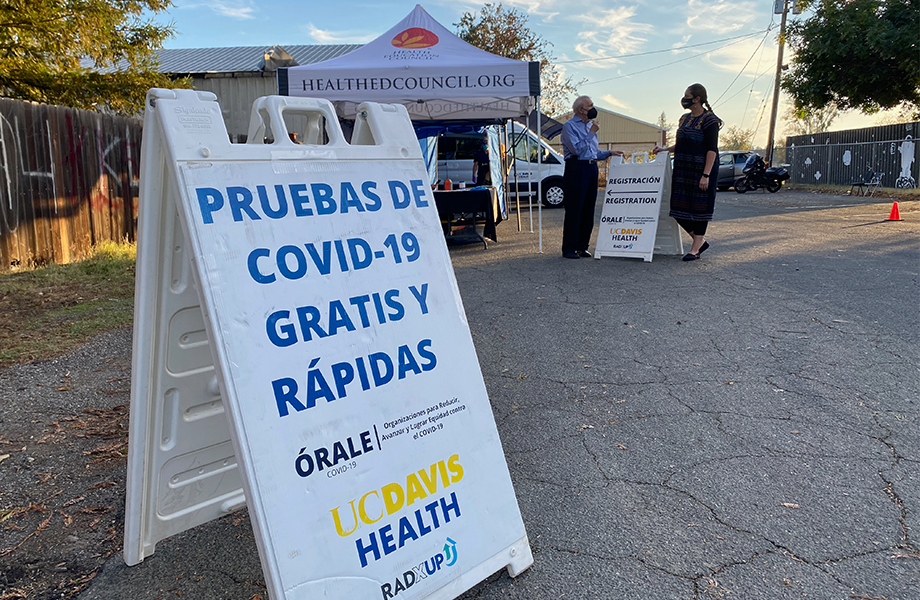
During the pandemic, the Center for Reducing Health Disparities received grants to administer COVID-19 testing and vaccination in Knights Landing and other medically underserved communities.
Reducing disparities during COVID
A vivid illustration of the center’s mission emerged during the COVID-19 crisis.
Early in the pandemic, communities of color in Sacramento and across California were sick with the COVID virus at much higher rates than other groups. By May 2023, Latinos represented about two-thirds (66.5%) ofCOVID-19 deathsamong Californians ages 35-49, or 41% of the population.
The disparity reflected underlying conditions: Many Latinos worked essential jobs and lacked protective equipment. They also lived in homes with family members of different generations, which made isolation difficult.
“The pandemic was a blunt reminder of some realities we knew all along: Latinos are central to the essential workforce and now there was an urgent need to stop them from dying,” Aguilar-Gaxiola said. “This was a ‘perfect storm’ situation because many Latinos also lack health insurance and that meant limited access to COVID testing.”
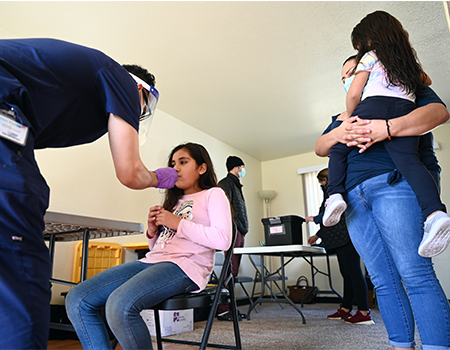
That’s when Aguilar-Gaxiola and his team advanced a new era of health equity. The center obtained millions of dollars in federal and state grants to partner with community organizations. Together, they administered over 6,000 rapid antigenCOVID testsin neighborhoods with high Latino, African-American and other underserved populations.
Later, when the vaccine became available, the team and its partnersdelivered more than 6,300 doses.Testing and vaccine efforts reached uninsured people in migrant labor camps, churches, grocery store parking lots and community centers across more than 100 sites.
“Providing direct patient care wasn’t in our original plans in 2005,” Aguilar-Gaxiola acknowledged, “but during COVID it was meaningful, necessary, and timely and we’re very proud of it.”
The initiatives impressed then-U.S. Secretary of Health and Human Services Xavier Becerra. Hevisitedcenter-supported vaccine clinics in Sacramento, and held them up as a nationwide model for delivering care to underserved communities.
Transforming mental health access
When Solano County leaders sought to improve access to mental health services for underserved populations, they turned to the center for help.
The Center for Reducing Health Disparities organized COVID testing at locations convenient to vulnerable populations, including families in a rural Yolo County migrant housing community.
Latinos, Filipino Americans and LGBTQ communities were using mental health services at lower rates than others and the county’sBehavioral Health Divisionwanted to change that. With support from a $6 million, five-year state grant, the Center for Reducing Health Disparities identified culturally and linguistically appropriate strategies to encourage members of the three groups to access mental health care.
The resulting project, known as theInterdisciplinary Collaboration and Cultural Transformation Model (ICCTM), was hailed a “game-changer” by the county due to the boost in mental health services utilization. Calls to the mental health hotline services among county residents increased by 29%, and even higher among the three communities of focus. Filipino Americans increased calls by 32%, Latinos by 41% and LGTBQ+ by 309%.
Building trust through meaningful community engagement
The center is nationally recognized for its expertise in meaningful community engagement to advance health and mental health equity. Central to this work is equipping community partners with outreach tools grounded in both research and real-world practice to reach underserved populations.
Aguilar-Gaxiola is a key co-author of the “Principles of Community Engagement,” 2ndand 3rdeditions. It’s a sort of bible for community engagement many public health practitioners, nonprofit leaders and researchers around the country rely on. The principles emphasize the importance of trust and trustworthiness between communities and institutions.
For example, reaching rural Latino farmworkers who have high rates of diabetes might involve trainingpromotoras— trusted community members — to teach nutrition classes, in Spanish, at churches.Promotoraswould then encourage community health clinics to open evenings and weekends to care for the workers during convenient hours.
“Trustworthiness is front and center in meaningful community engagement,” Aguilar-Gaxiola said. “Without it, we would never make any lasting inroads at reducing health disparities among the populations that most need improved health outcomes.”
Under Dr. Sergio Aguilar-Gaxiola’s leadership, the Center for Reducing Health Disparities has not only advanced health equity in and around the Sacramento region but statewide, nationally and internationally.”—Debra Oto-Kent, executive director, Health Education Council
Aguilar-Gaxiola and the center are also recognized for assessing community engagement effectiveness. In 2019, theNational Academy of Medicinetapped him to co-chair a major project onmeasuring meaningful community engagementin health and health care. Through the project, the center developed key resources and further raised its national profile.
Asia Williams, a program officer at the Washington, DC-based academy, said the center’sworkhas become indispensable for many. This includes organizations and professionals across public health, health care, policy and community work, including government agencies and health centers.
“Having Sergio and his organization involved in this project has been invaluable, and the center’s approach to authentic community partnership is truly distinctive,” Williams said. She added that the center has a long history of “providing training and resources that make programs accessible, multilingual and culturally relevant.”
As the Center for Reducing Health Disparities enters its 21st year, Aguilar-Gaxiola and his team are reflecting on the difference they’ve made. The center has undoubtedly reduced health and mental health disparities — work that’s difficult to quantify but visible in healthier, more empowered communities across the nation.
The center, which operates within the UC Davis School of Medicine, has successfully addressed the questions Aguilar-Gaxiola posed in 2005: The team has developed effective, innovative solutions to reduce disparities, and that work continues to evolve with each community served.
"We applaud the center for two decades of groundbreaking work,” said School of Medicine DeanSusan Murin,” and for being part of our medical school’s multifaceted efforts to advance health equity.”