How UC Davis Health meets the growing need for heart rhythm care
By Liam Connolly
Electrophysiology team is using advanced treatments, innovative technology and cutting‑edge research for arrhythmia patients
(SACRAMENTO)
The need for advanced heart rhythm care is rising across the country as more people are diagnosed with heart rhythm problems.
New national estimates show that about 10.5 million U.S. adults have atrial fibrillation (AFib), the most common type of arrhythmia. This number is three times higher than previous estimates, showing how quickly AFib has become a major heart condition.
Research from UC Davis Health heart specialists shows that using catheter ablation, instead of medications alone, can lower the risk of death and stroke for people with AFib. Yet fewer than 1% of patients receive ablation early, when it can help the most.
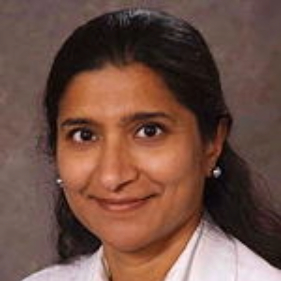
“AFib diagnoses have increased across all groups over the past decade, partly due to aging populations and higher rates of high blood pressure, diabetes, obesity and alcohol intake,” said Uma N Srivatsa, professor of cardiovascular medicine and director of arrhythmia services at UC Davis Health.
“Our data supports wider use of ablation and greater awareness of its benefits. Health systems across the country need to be ready to care for the growing number of patients who need EP treatments.”
Electrophysiologists find and treat problems with the electrical signals that help the heart beat in rhythm.
Electrophysiologists find and treat problems with the electrical signals that help the heart beat in rhythm. When these signals misfire, a person can develop arrhythmia. Doctors use catheters, mapping tools and implanted devices to diagnose and treat these rhythm problems.
Jenerine Magri, interim assistant nurse manager of the UC Davis Health EP Lab, explains it simply:
“People often think electrophysiology is the same as the cardiac catheterization lab, but it’s not. They work on the heart’s blood vessels — so they’re like plumbers. We work on the heart’s electrical system, so we’re the electricians.”
The current UC Davis Health EP Lab opened in 2010 as part of a major expansion. It offers a wide range of services, including:
Clinical care and research programs
Advanced education for specialization
Medication management
Radiofrequency ablations
Cryoablation
Pulsed field ablation
Stereotaxis magnetic navigation
Cardioversions
Pacemaker (standard and leadless), AICD implants and cardiac resynchronization therapy
Lead extractions
Tilt table tests
“Cardiac electrophysiology is an eccentric field where medicine intersects with physics,” said M. Bilal Munir, associate professor of cardiovascular medicine. “We care for a very unique group of patients, and every member of the team plays a key role in helping them live healthier, safer lives.”
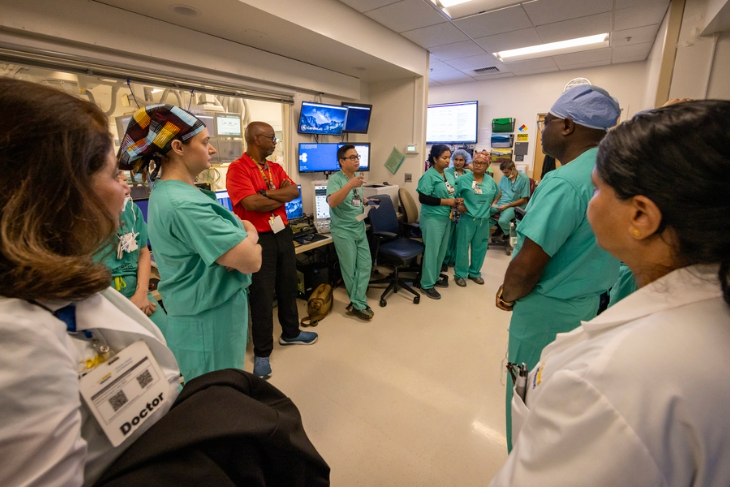
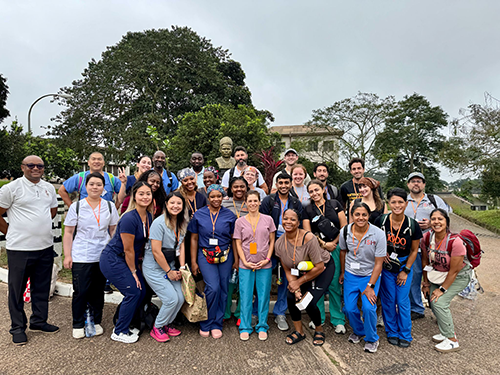
The Electrophysiology care team includes physicians, fellows, nurses, EP technicians, environmental services staff and anesthesia partners.
Teamwork powers the EP lab
The EP lab relies on highly coordinated teamwork. The care team includes physicians, fellows, nurses, EP technicians, environmental services staff and anesthesia partners.
During an EP procedure, many tasks happen simultaneously. Every role connects to patient safety.
“Our entire team has to work smoothly together to achieve the best results for patients,” Srivatsa said. “Our team is always doing important work behind the scenes, and our physicians could not do what they do without them.”
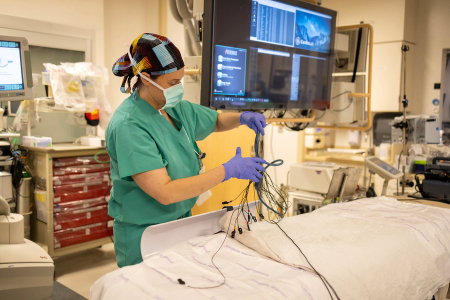
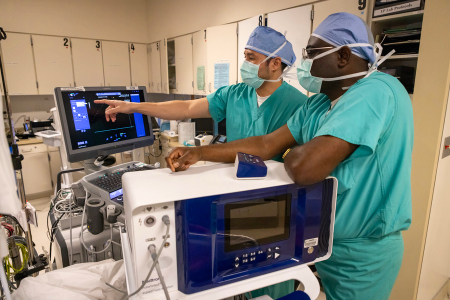
Equipment management is another critical part of EP care. Technology helps the team stimulate the heart, map abnormal rhythms and perform ablations with the right type of energy. They do this all while monitoring the patient in real time.
EP technicians have advanced training. Many come from nursing, EKG technology or cath lab backgrounds.
“I feel that being on the EP team is like reaching the ‘crown jewel’ of the field. It requires skill, precision and a deep understanding of the heart’s electrical system. When I meet with patients, I tell them I work with a phenomenal team. I trust them completely — and you can, too.”—Uma N Srivatsa
“I feel that being on the EP team is like reaching the ‘crown jewel’ of the field,” added Srivatsa. “It requires skill, precision and a deep understanding of the heart’s electrical system. When I meet with patients, I tell them I work with a phenomenal team. I trust them completely — and you can, too.”
New technology, research and the role of AI
As demand grows, the UC Davis Health EP Lab is using new tools and research to better diagnose and treat heart rhythm disorders.
Technology helps the team stimulate the heart, map abnormal rhythms and perform ablations with the right type of energy.
One of the newest technologies is Pulsed Field Ablation (PFA). PFA uses short, high‑energy electrical pulses instead of heat or cold. These pulses create tiny openings in cell membranes and destroy only the abnormal tissue causing the arrhythmia.
“New AI algorithms have the potential to improve patient flow and help us work more efficiently,” Srivatsa said. “We need to confirm their reliability and learn how to maximize their benefits for our patients.”
The future of cardiac EP at UC Davis Health
As the need for EP care grows, UC Davis Health is preparing for the future. In 2030, the medical center will open the new 14‑story California Tower, which will include three dedicated EP labs. This expanded space will help the team perform more procedures and care for more patients.
“As an academic institution, we take pride in excelling in clinical care, education and research,” Srivatsa said. “Our team is ready to make sure every patient receives the services they need and the best care possible.”