
Falcon update: Chicks receive their names
Tune in: Watch the falcons live
Update: June 8, 2026
The UC Davis Health peregrine falcons are entering an exciting new phase, and this year’s chicks now have names: Christina, Annie and Genevieve.
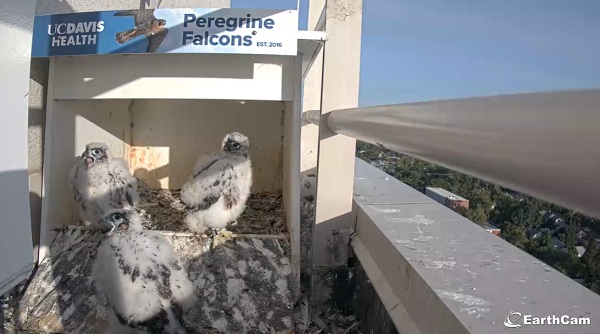
Over the coming weeks, these young falcons will begin testing their wings as they prepare for their first flights. This stage is a critical moment in their development — and one where the campus community can play an important role.
It’s common for fledgling falcons to end up on the ground as they learn to fly. When this happens, quick and careful intervention can make a significant difference. At another regional nest site in San Jose, three of four chicks recently landed on the ground during early flight attempts and were safely returned to the nest, helping prevent injury.
UC Davis Health staff are encouraged to keep an eye out for the falcons during this period.
- If a falcon is seen on the ground, do not approach or attempt to handle it
- Call the UC Davis Health Police Department non-emergency line at 916-734-2555, available 24 hours a day
- Police will notify wildlife experts, including William Corbett, to ensure a safe response
This support is especially important in the next month as the chicks begin flying more frequently.
Additional updates on Christina, Annie and Genevieve will be shared as they continue to grow and explore the campus skies.
Update: June 2, 2026
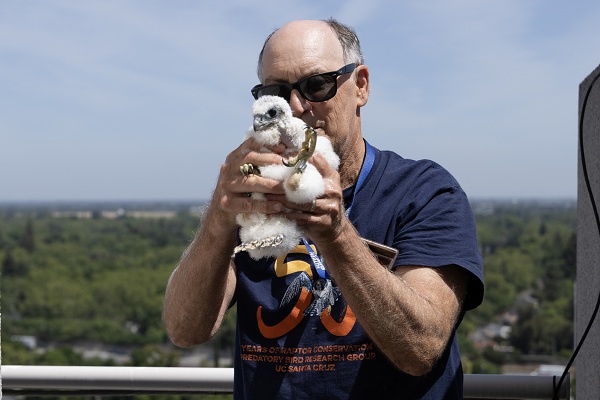
Three peregrine falcon chicks reached an important milestone this week as wildlife experts placed identification bands on their legs, a routine step that supports long-term conservation efforts.
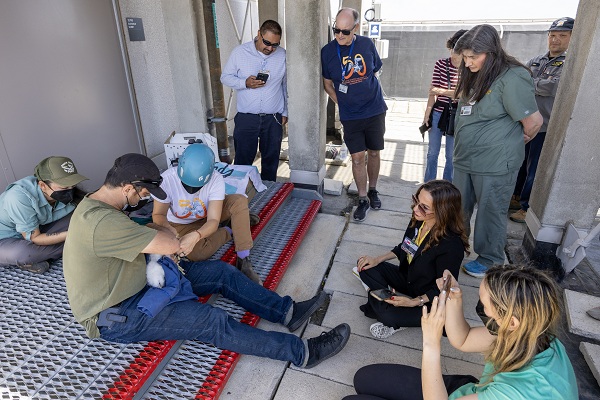
Banding allows researchers to track individual birds throughout their lives. Each band carries a unique number that helps monitor migration, nesting success, lifespan and overall population health. For peregrine falcons, once listed as endangered, this data continues to play a key role in sustaining the species’ recovery.
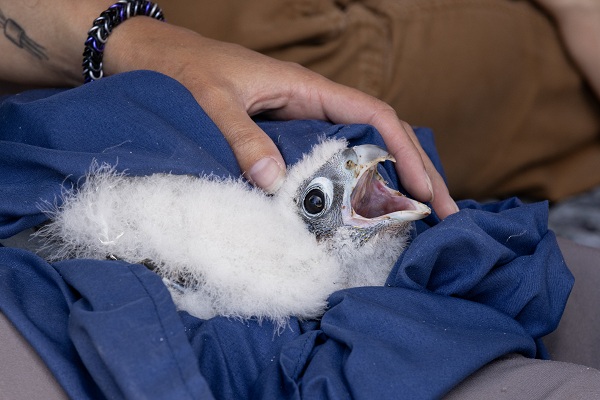
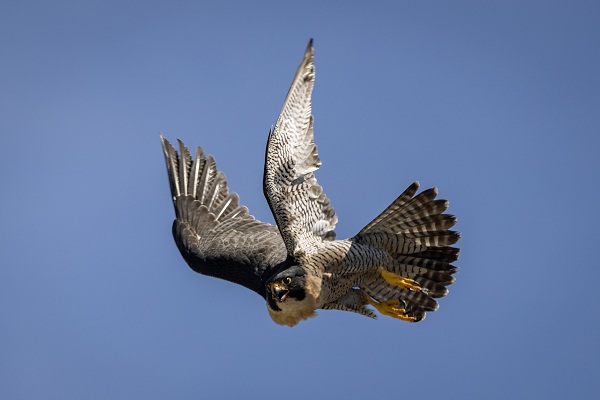
The adult falcons circled overhead during the banding, calling out and closely monitoring the activity. They stayed nearby throughout the process, a protective response as they ensured their chicks remained safe.
William Corbett, a procurement supervisor at UC Davis Health and the organization’s resident falcon expert, said the young birds are thriving this season.
“The banding process is an important way to help us follow these birds as they grow and eventually leave the nest,” Corbett said. “This year’s chicks are looking very healthy and strong. They’re doing very well and beginning to spread their wings, which is exactly what we want to see as they get ready for those first flights.”
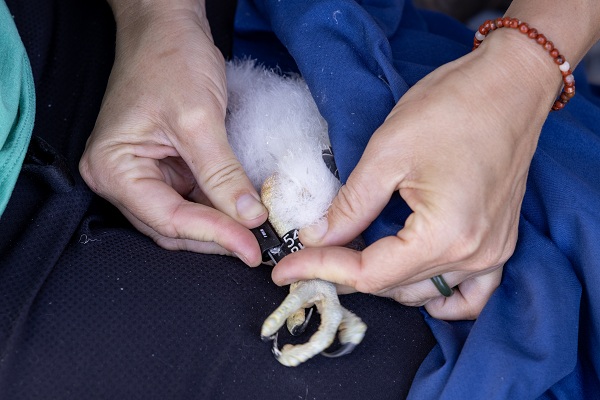
The process is brief and designed to minimize stress. While the chicks remain in the nest and are not yet able to fly, trained experts carefully handle each bird, secure lightweight bands around their legs and return them safely. The bands do not interfere with movement or growth and remain with the falcons for life.
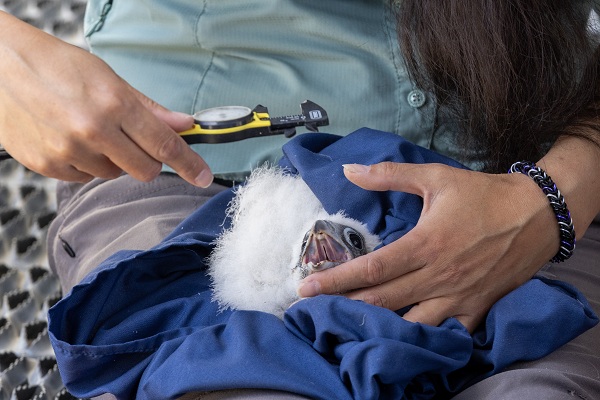
“It was a special experience to be this close to the birds during such an important moment,” said Christina Mintner, associate chief operating officer for Ambulatory Care Services. “Being part of this process really highlights how connected our campus community is to these falcons. There’s a shared sense of excitement and pride in watching them grow, and it reflects both our commitment to stewardship and our connection to nature.”
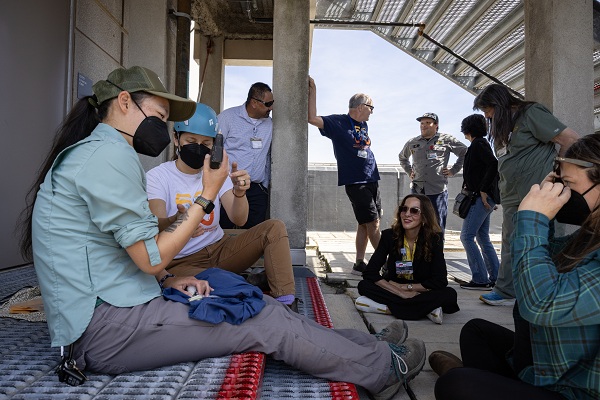
In the coming weeks, the falcons will continue building strength, exercising their wings and exploring the nest edges. These early movements mark a critical stage as they prepare to leave the nest and take their first flights.
Update: May 15, 2026
Three peregrine falcon chicks continue to grow in the campus nest, with both parents actively sharing care of the young birds.
One chick from the brood died, a reminder of the challenges young birds can face in the early days after hatching. The chick was removed from the nest for observation.
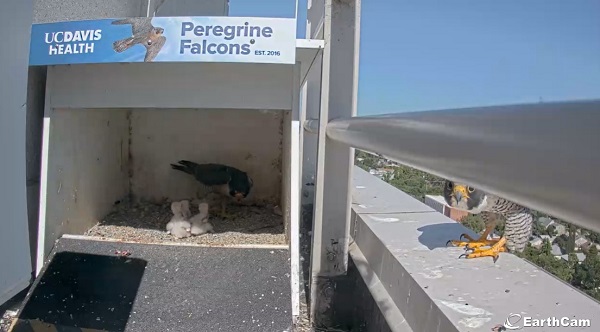
The remaining three chicks appear healthy and are beginning to move around the nest as they gain strength.
The adult falcons are taking turns tending to the chicks, with the female spending much of the day shielding them and keeping them protected. Both the male and female are regularly bringing food back to the nest, and the chicks are feeding well.
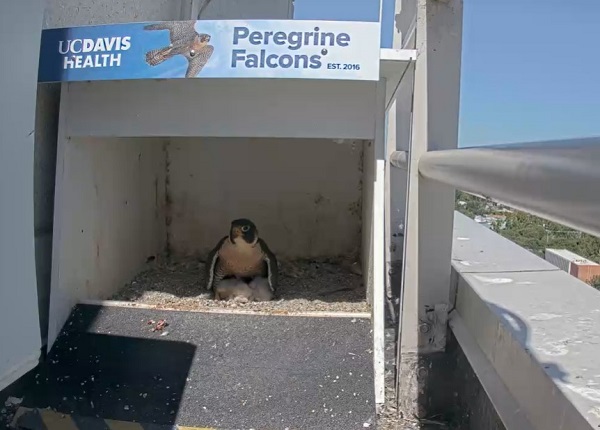
Activity in the nest is expected to increase in the weeks ahead. Viewers can watch for the chicks to grow rapidly, develop thicker down and early feathers, and become more active as they explore the nest box. In time, they will begin flapping their wings and preparing for their first flights.
Falcon observers will continue monitoring the nest and sharing updates as the chicks reach new milestones.
Update: May 12, 2026
The fourth peregrine falcon chick has hatched in the campus nest, completing the brood of four.
The final chick emerged within the past day, joining siblings that began hatching on Mother’s Day. All four chicks appear healthy, with the parent falcons actively feeding them and keeping them warm.
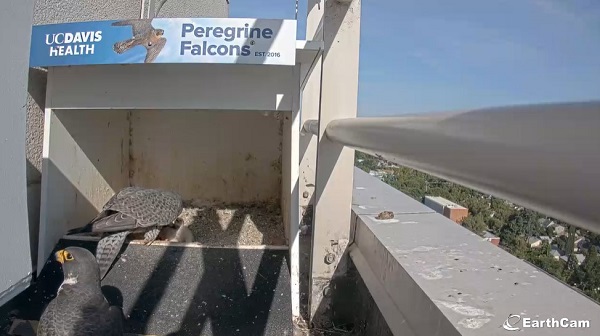
As activity in the nest increases, observers have also noted the presence of another peregrine falcon near the nesting area earlier this month. The bird, identified by band number 65/AW, is a male hatched at the UC Davis Medical Center nest in 2023.
Falcon observers will continue to watch closely in the coming days and weeks to see how this interaction develops and to follow the growth of the four chicks.
Update: May 11, 2026
Three chicks have hatched in the campus falcon nest, marking a Mother’s Day milestone for the resident peregrine pair.
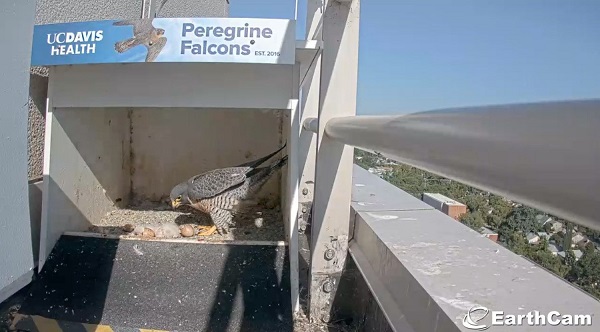
The first hatchling emerged Sunday, followed by two more shortly after. One egg remains in the nest, and observers are watching closely to see if it will hatch in the coming days.
The new arrivals are already being tended to by their parents, who are keeping the chicks warm and well fed. As the hatchlings grow, viewers can expect more movement and activity in the nest and, soon, the first glimpses of their developing personalities.
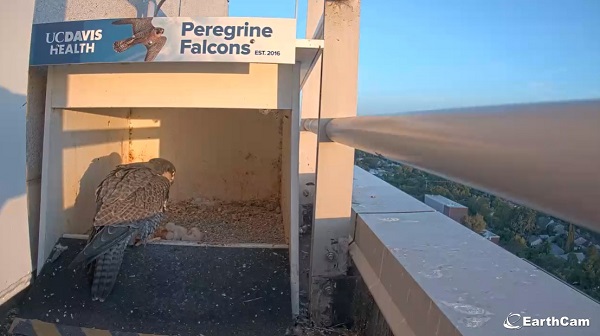
Updates will continue as the remaining egg nears its expected hatch and the chicks continue to grow.
Update: May 5, 2026
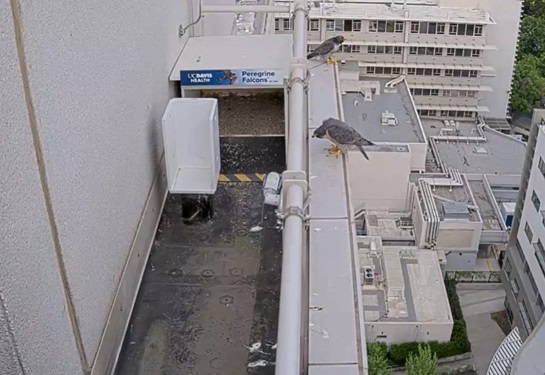
The peregrine falcons nesting atop the UC Davis Medical Center remain settled in for the long wait, with four eggs still unhatched. The adult pair has been taking turns incubating the clutch, carefully trading places throughout the day to keep the eggs warm and protected.
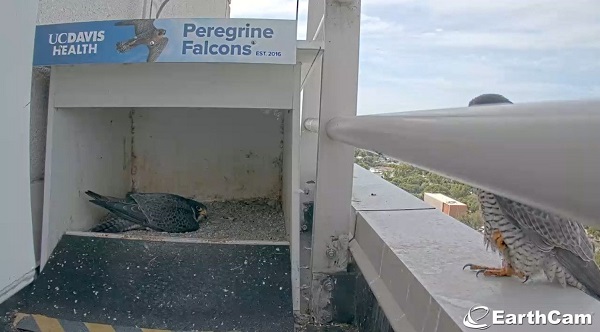
Two peregrine falcons rest at a nesting box on a UC Davis Health building, part of a long-running effort to support urban raptor nesting on campus.
Update: April 14, 2026
All signs point to a full nest this season, with the UC Davis Health peregrine falcon appearing to settle in with a brood of four eggs.
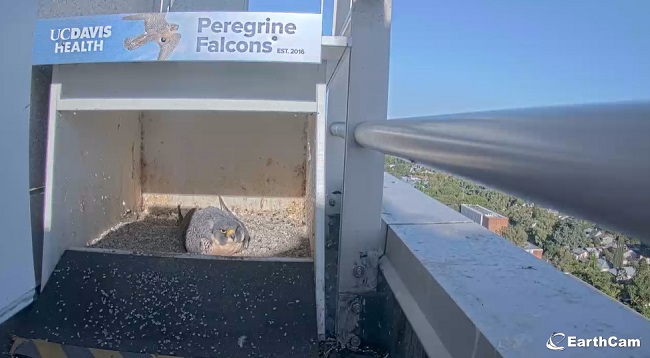
The mother falcon is now in full nesting mode, spending most of her time tucked low in the nest, keeping the eggs warm and protected. Her movements have slowed and become more deliberate — a clear signal that incubation is well underway.
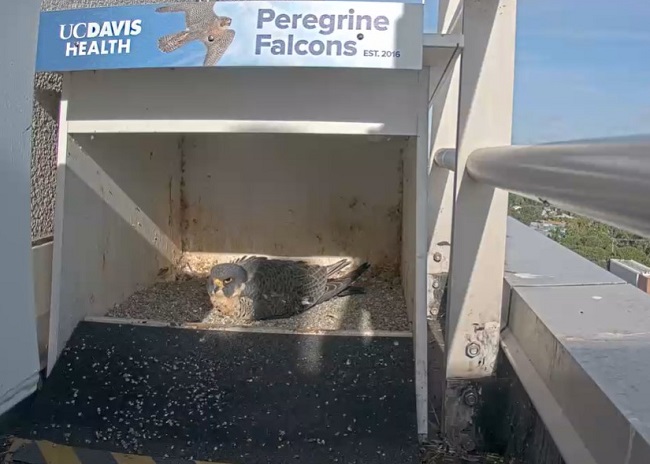
Meanwhile, the father falcon continues to make regular appearances, stopping by the nest area periodically to check in on the family before heading back out. Together, the pair is settling into the steady rhythm of nesting season, marking another exciting milestone for this year’s falcon watch. Watch live cameras.
Update: April 8, 2026
Add one more to the count.
Falcon-eyed viewers and nest cameras confirmed the presence of a fourth egg, marking yet another change inside the UC Davis Health falcon nest. In just over a week, the season has changed from “will she this year?” to “how many?”
With four eggs now, attention turns to what comes next: a fifth egg, or the incubation phase?
Update: April 6, 2026
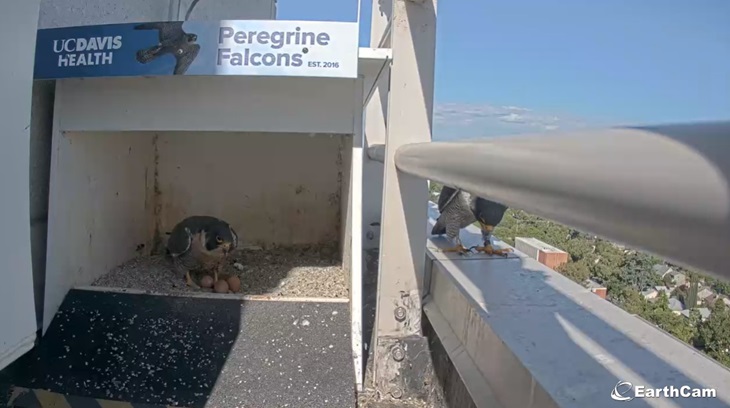
Over the weekend, the mother falcon laid a third egg, continuing a nesting season that has already delivered several unexpected turns.
What began with uncertainty has quickly grown into a season full of momentum—and, once again, the falcons aren’t done keeping us on our toes.
Update: April 2, 2026
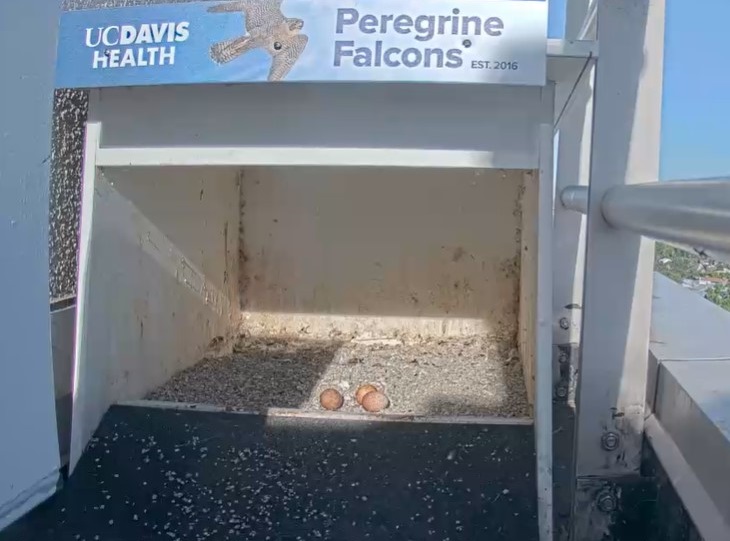
The falcons have added another egg to the nest. Shortly after noon, the mother falcon laid a second egg, building on a nesting season that just days ago appeared uncertain. The two eggs are now visible on the nest cameras.
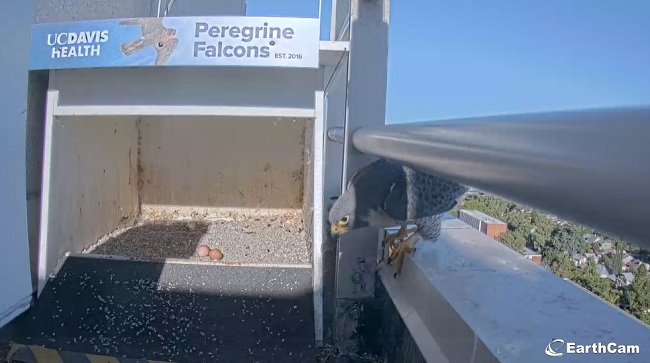
Update: March 31, 2026
Talk about a plot twist.
Less than 24 hours after sharing that there was a real possibility the falcons might not lay eggs this season, the mother falcon proved once again that nature doesn’t follow our timelines.
Sometime overnight, she laid her first egg.
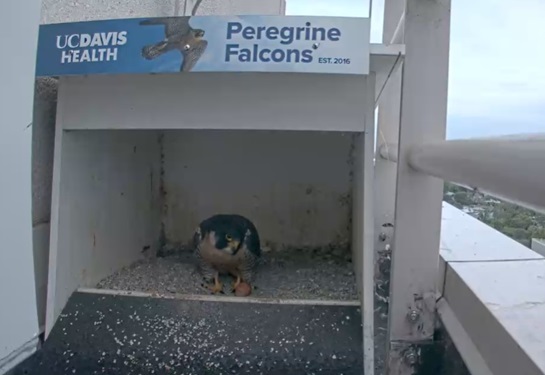
Based on the nest camera footage, the event occurred quietly and without fanfare. When the sun set Monday evening, the nest was still empty. By the time dawn broke Tuesday morning, a single egg had appeared—transforming a season of uncertainty into one of renewed anticipation.
For everyone watching, it was a reminder why this nest keeps captivating year after year: just when it seems like the story might be winding down, the falcons surprise us with a performance worthy of prime-time interest.
Update: March 30, 2026
It has been nearly two months since peregrine falcons were first spotted near the UC Davis Medical Center this year, prompting a familiar question from fans of the birds: Where are the eggs?
In recent years, egg-laying has followed a fairly predictable timeline. Last year, the female falcon laid her first egg on March 17 and her final egg on March 28. In 2024, the first egg appeared on March 12. While an exact date isn’t available for 2023, the timing of the first hatch suggests the eggs likely arrived in late March.
This year, however, the nest remains empty.
William “Bill” Corbett, a procurement supervisor at UC Davis Health and a longtime falcon expert, said the delay is unusual. Peregrine falcons he tracks in San Jose laid their eggs weeks ago, he said, raising the possibility that the UC Davis Health birds may have chosen a different location.
His team plans to check other areas of the roof to determine whether the falcons established an alternate nest.
“If we don’t have eggs by the end of this week, I don’t feel like it’s going to happen,” Corbett said.
Original Post
A pair of peregrine falcons has once again returned to their nest atop UC Davis Medical Center. The nest sits at a safe distance from the hospital’s busy helipad, offering the birds a secure place to call home for the spring.
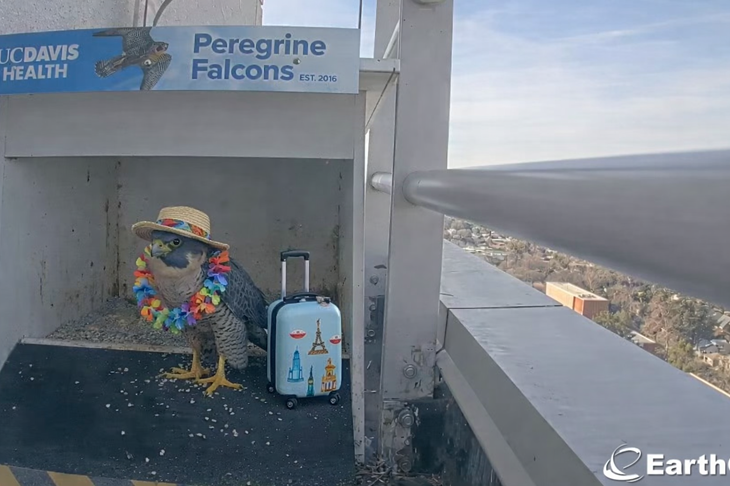
This season, the nest features a new, cleaner and larger sign and a ramp. The falcons have already started checking it out as they prepare for their next clutch of eggs.
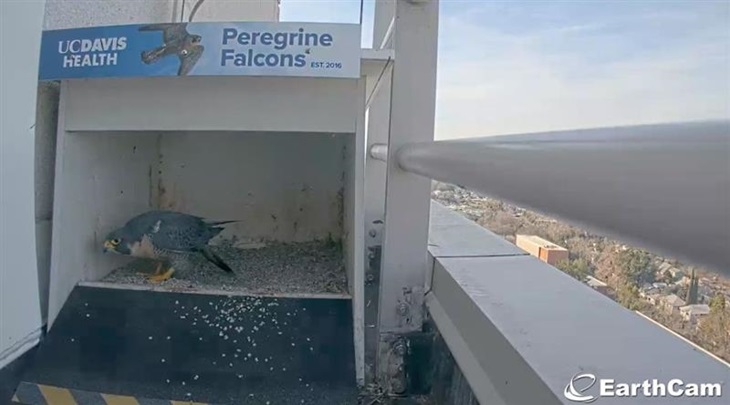
Last year, the female falcon laid five eggs, four of which successfully hatched. The falcons had three female chicks and one male. Chicks usually begin hatching in late April. Corbett will continue to share insights about these remarkable birds — and why their presence here is so special — throughout spring.