

MIND INSTITUTE RESEARCH
Translational Psychophysiology and Assessment Laboratory
Focusing on improving methods to detect treatment benefits in people with neurodevelopmental conditions.
About Our Lab
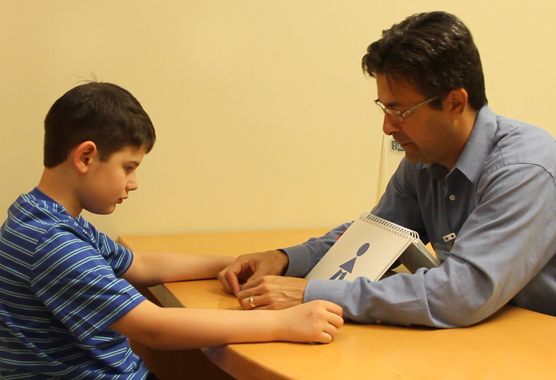
The Translational Psychophysiology and Assessment Laboratory (T-PAL) focuses on improving methods for assessing and detecting treatment benefits in clinical trials and other interventions, especially in people with neurodevelopmental conditions such as fragile X and Down syndromes and autism, as well as people with neurodegenerative changes related to FXTAS (fragile X-associated tremor/ataxia syndrome). Current studies include a “clinical trial readiness project for FXTAS (identifying ideal clinical, brain MRI markers, and biomarkers); a longitudinal study to identify risk and protective factors for FXTAS; the investigation of a smartphone-based app as a way for parents to report ADHD symptoms and behavioral challenges in children with neurodevelopmental conditions; and a long-term study of the NIH Toolbox Cognition Battery in youth with intellectual and developmental disabilities. David Hessl, professor in the Department of Psychiatry and Behavioral Sciences directs T-PAL.
Methods Used:
Contact Us
If you have questions about T-PAL, or would like to learn more about scheduling an appointment, please contact David Hessl, Ph.D. at drhessl@health.ucdavis.edu.
- neuropsychological assessments for cognition, memory, attention and emotion
- ecological momentary assessment of challenging behaviors and executive functioning
- tablet-based assessments of executive functioning, processing speed, and language
- infrared and retinal eye-tracking
- electroencephalography (EEG) and event-related potentials (ERP)
Current Research Studies
This is a clinical trial readiness project funded by the National Institute of Neurological Disorders and Stroke (NINDS) focused on developing and validating the ideal measures and infrastructure for future clinical trials for fragile X-associated tremor/ataxia syndrome (FXTAS). Currently there are no specific treatments for this progressive neurodegenerative disease that affects carriers of the fragile X premutation. However, we expect that gene therapies and other medications that target the underlying mechanisms of FXTAS to be available within the next 5 years. The project will enroll 100 patients with FXTAS at three centers (UC Davis, University of Michigan, and Rush University) and follow them over a two-year period, evaluating the sensitivity of neurological, neuropsychological, brain MRI, and quality of life measures to be used in future trials. The study will also establish standardized procedures and infrastructure needed for these studies. The team and project will be guided and informed by a panel of patients with FXTAS and their care partners, clinical and research professionals and NIH representatives.
If you or someone you know would be interested to participate in this study, please contact our Study Coordinator at ACTforFXTAS@health.ucdavis.edu or by phone at 916-598-3351.
The Toolbox Study aims to explore whether certain types of intellectual or cognitive tests are reliable, valid and sensitive in evaluating treatment responses among individuals with intellectual disability. The NIH Toolbox Cognitive Battery has been shown to accurately measure various cognitive skills across a wide age range, but has yet to be widely adopted among individuals with intellectual disability. In 2015, the Toolbox Study began enrolling children, teens, and young adults with Down syndrome, fragile X syndrome, autism, and intellectual disabilities from other causes. In 2020, the Toolbox Study received renewed funding to continue following current participants and enrolling participants with an expanded age range.
From the first phase of the study, we published a paper in the journal Neurology that detailed how well the battery performs in children and young adults with intellectual disability. Briefly, we proved that with some accommodations and adjustments, people with intellectual disabilities can provide scores on the test that are, in most ways, as reliable and valid as scores from typically developing people. This is a big achievement because it promotes inclusion in research for people with intellectual and developmental disabilities (IDD) who may have previously been excluded from such opportunities due to a misperception that they are not able to be assessed or participate in study activities. This good news led several investigators to choose the Toolbox test as an outcome measure in clinical trials, another important indicator of progress. This means, because the Toolbox test was successful in our study, it is being used to measure specific cognitive skills to track how well a treatment might be working.
Participation
Your child may be eligible to participate in the Toolbox Study if they:
- Are between 4 and 25 years old at the time of enrollment
- Have been diagnosed with intellectual or developmental disability caused by Down syndrome, fragile X syndrome, Williams syndrome, or another/unknown cause
Families who enroll in the study will:
- Come to the MIND Institute for a study visit lasting approximately 6 hours
- Their child will participate in a variety of cognitive assessments, including the NIH Toolbox Cognitive Battery
- Parents/caregivers will be asked to answer questions about their child’s home environment, behavior, and functioning
- Participants will be invited back for a follow-up visit 2 years after their first study visit
- Receive compensation for both travel and participation in the study, and receive detailed assessment results
If you or someone you know would be interested to participate in this study, please contact Study Coordinator at toolboxstudy@health.ucdavis.edu or by phone at 916-703-0121 or 916-598-3351.
For interested individuals with Down syndrome or fragile X syndrome who are over 25 years old, please see the Toolbox Study in Aging study.
The main purpose of this study is to test the treatment sensitivity of an assessment tool called the National Institute of Health Toolbox Cognition Battery. The study will determine whether these measures detect treatment benefits of a medication called Quillivant Extended Release in youth with intellectual and developmental disabilities who also have ADHD.
Participation
Your child may be eligible to participate in the Toolbox Study if they:
- Are over 25 years old at the time of enrollment
- Have been diagnosed with intellectual or developmental disability caused by Down syndrome or fragile X syndrome
Families who enroll in the study will:
- Come to the MIND Institute for a study visit lasting approximately 6 hours. Participants may also be eligible for an in-home assessment without having to travel to the MIND Institute
- Participate in a variety of cognitive assessments, including the NIH Toolbox Cognitive Battery
- Caregivers will be asked to answer questions about the participant’s home environment, behavior, and functioning
- Participants will be invited back for a follow-up visit 2 years after their first study visit
- Receive compensation for both travel and participation in the study, and receive detailed assessment results
If you or someone you know would be interested to participate in this study, please contact Study Coordinator at toolboxstudy@health.ucdavis.edu or by phone at 916-703-0121 or 916-598-3351.
Email:
toolboxstudy@health.ucdavis.edu
For interested individuals with intellectual disability caused by Down syndrome, fragile X syndrome, or other causes under 25 years old, please see the Toolbox Study.
FORWARD-MARCH is the next step following a highly successful research study called FORWARD (Fragile X Online Registry with Accessible Research Database) that was started in 2012.
The FORWARD study created the largest database of information on FXS in the United States. Data from the FORWARD study is being used by researchers to learn about the lives of people with FXS. Thanks to families who contribute to FORWARD, researchers are learning about important things like medication use, behaviors, and development over time. These findings are shared with other researchers and clinicians in order to help develop targeted therapies and treatments.
The FORWARD-MARCH (Multiple Assessments for Research Characterization) project will collect more detailed information from participants with FXS and add it to the existing FORWARD database. FORWARD-MARCH continues the mission of FORWARD to better understand FXS in order to improve the lives of children and adolescents with FXS and the lives of their families.
- Individuals with Fragile-X born between 2003 and 2020
If you or someone you know would be interested to participate in this study, please contact Study Coordinator at toolboxstudy@health.ucdavis.edu or by phone at 916-703-0121 or 916-598-3351.
The main purpose of this study is to test an assessment tool called the National Institute of Health Toolbox Cognition Battery. We hope that using this assessment tool will help us find out how well a medication called Quillivant Extended Release is working to improve ADHD and Intellectual Disability conditions.
- 6-24 years old
- Fragile X Syndrome, Down syndrome, Intellectual Disability, Autism, 22q11.2 Deletion Syndrome, ADHD, or other neurodevelopmental disability
- Symptoms of ADHD
If you or someone you know would be interested to participate in this study, please contact Study Coordinator at toolboxstudy@health.ucdavis.edu or by phone at 916-703-0121 or 916-598-3351.
Fragile X carriers are individuals with the FMR1 premutation, who are at risk of developing a neurodegenerative condition called fragile X-associated tremor/ ataxia syndrome (FXTAS) in later life. FXTAS symptoms include tremor, balance problems, cognitive changes, and a range of other neurological problems.
This study, co-directed by David Hessl, Ph.D. Susan Rivera, Ph.D., and Flora Tassone Ph.D, aim to discover genetic, brain and cognitive factors that may precede or occur with the onset of FXTAS in adult male fragile X carriers. This is the first longitudinal study of this population. We study intellectual function, motor function, executive function, memory, dexterity, and balance, as well as learn about participants’ psychological health. The brain health portion of our study is completed through magnetic resonance imaging (MRI). Information gathered from these scans includes size, shape, and integrity of the brain and its structures.
We know that many of our participants and their family members have questions about the premutation, especially how to identify early signs of neurodegeneration and most importantly how to treat or prevent FXTAS. While this is not a treatment study, it will provide extremely valuable information about the natural course of aging in these carriers that will inform treatment studies, and we are working hard, with Randi Hagerman, M.D. and others, to identify the most promising interventions to investigate. Our study will also help to develop and validate clinical or neuroimaging methods that could be used to track effectiveness of these interventions.
We continue to recruit new participants, and also to bring participants back for follow up visits, and we have enjoyed getting to know them over time. We have learned a great deal about the structure of white matter in the brain, aspects of social cognition, anxiety, and age-related patterns of changes in brain structure. We look forward to exploring the longitudinal data over the course of this study.
- Male
- 50 years and older
- Premutation Carriers with NO symptoms of FXTAS (in North America)
- Control (Sacramento Area)
If you or someone you know would be interested to participate in this study, please contact Study Coordinator our at TrajectoriesStudy@health.ucdavis.edu or by phone at 916-703-0470 or 916-465-0164.

Down Syndrome Resources
Down syndrome is a condition in which a person has an extra chromosome. Chromosomes are small of genes in the body. They determine how a baby's body forms and functions as it grows during pregnancy and after birth.

Fragile X Resources
Fragile X syndrome (FXS) is the most common inherited cause of intellectual disability and the most common known single-gene mutation leading to autism spectrum disorders. The clinical features of FXS range from mild emotional, sensory and/or learning problems to severe intellectual disabilities and autism.

Research Participant Registry
Our Research Participant Registry (RPR) is designed to match potential participants with the MIND Institute's human research studies. Your participation in research plays a vital role in improving awareness, understanding, prevention, care, and treatment of neurodevelopmental disabilities.