From Labs to Lives: Providing Better Support for Children With Autism
‘From Labs to Lives’ series highlights human impacts of federally funded scientific research
(SACRAMENTO)
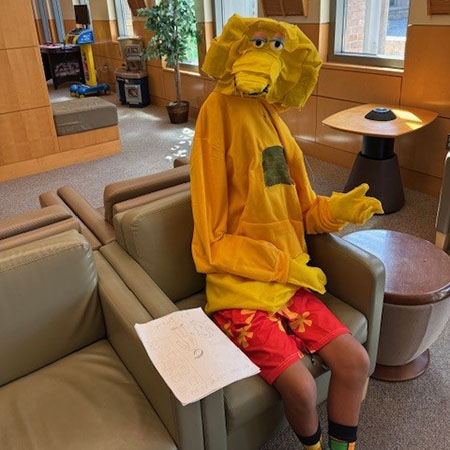
It’s not every day that someone brings a hand-sewn Big Bird costume to a research appointment at the UC Davis MIND Institute. But 11-year-old Benjamin Awalt really knows how to make an impression.
11-year-old Benjamin Awalt in his handmade Big Bird costume at a recent MIND Institute research visit.
Benjamin loves theater and creating costumes in his garage workshop. He is also autistic, diagnosed at age 3. Now, he’s taking on a new, important role: a participant in the Autism Phenome Project (APP). The federally funded research seeks to identify different subtypes of autism.
“The APP is about understanding the different developmental trajectories of autistic children,” said Christine Wu Nordahl, a professor in the Department of Psychiatry and Behavioral Sciences. “How do they change as they grow up? Are there subsets of children that follow distinct patterns of development? Our hope is to apply what we learn to help predict outcomes and support autistic individuals as they grow up.”
Because autism is a wide spectrum, Nordahl explained, there’s no single intervention or support that works for everyone. The APP team gathers blood samples, conducts behavioral assessments and tracks development from early childhood into early adulthood. They also obtain brain scans, which turned out to be a highlight of Benjamin’s visit.
“I saw my brain,” he said with a grin. “It was fun, honestly. I had to do something called an MRI.”
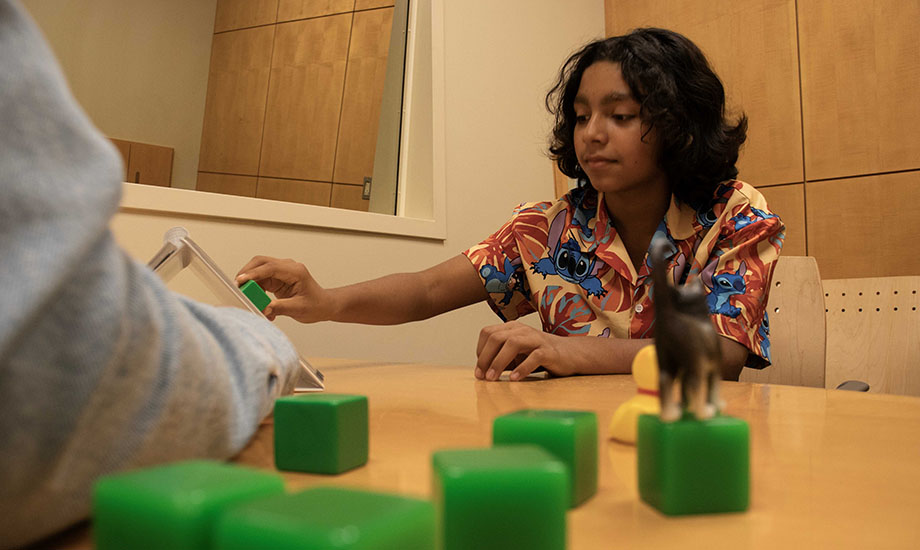
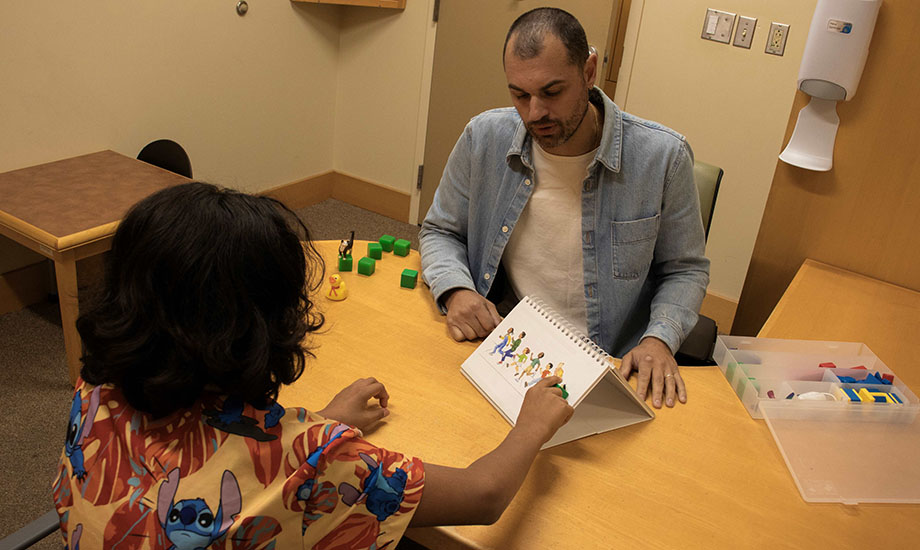
Benjamin Awalt works with a research team member at a recent MIND Institute visit.
Still, it wasn’t all easy. “I was experiencing something somewhat nervous for me,” Benjamin remembered. “I was a little scared of getting my blood taken.”
His courage paid off. Benjamin enjoyed talking with the researchers about his interests and activities and showing them his costume.
“I felt seen,” he said.
Taking part in research was also important to Benjamin’s mom, Brooke Myers-Awalt. “I think that knowledge is power, and I think that it’s really important that there is credible research being done and that it continues to be done, especially currently,” she said. “I think it’s super important to continue to learn more so we can support people with autism and people with other disabilities.”
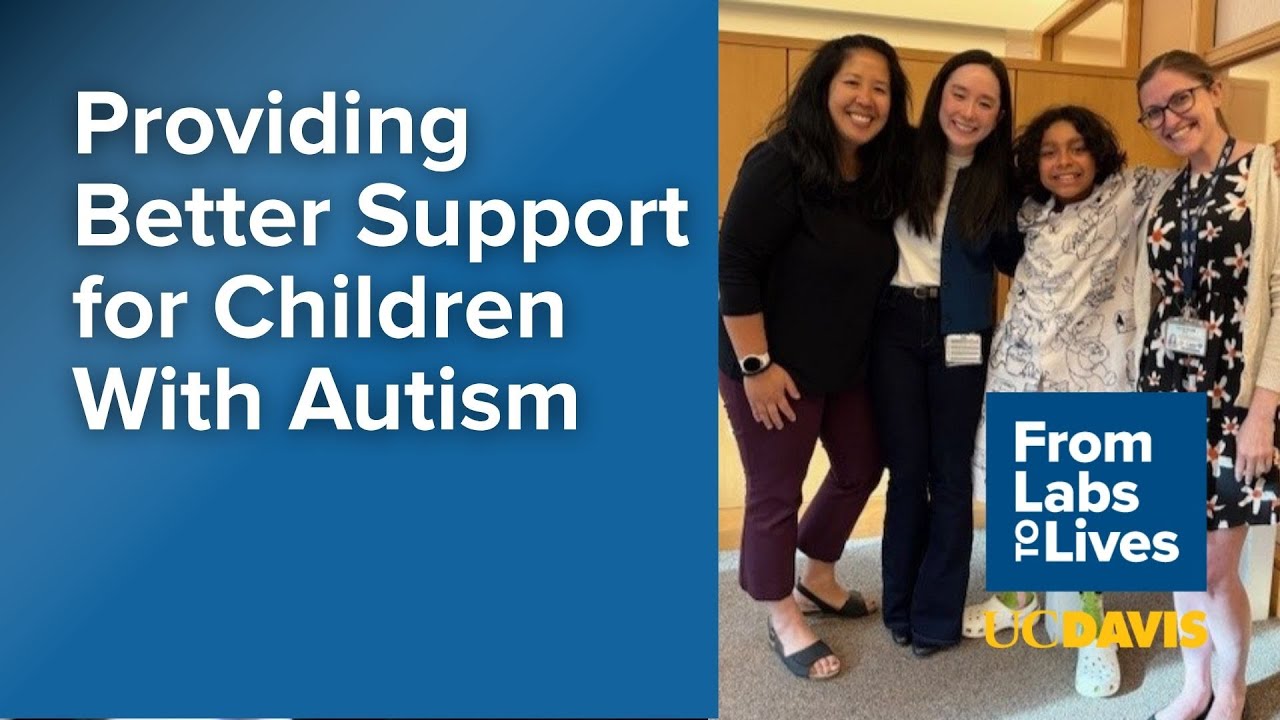
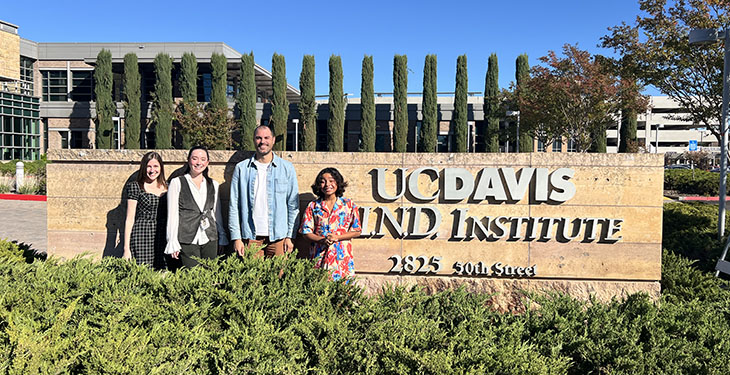
Benjamin Awalt and Autism Phenome Project researchers pose for a photo outside the MIND Institute.
From Labs to Lives: The human impact of research
In 2025, UC Davis launched a campaign to increase public understanding of the impact of university-led research. From Labs to Lives spotlights the impact of research across fields, from medicine to agriculture, technology to the environment.
Long-running research studies like the APP highlight the value of building a strong scientific foundation to improve identification, intervention and more personalized care.
The APP began in 2006 and has been federally funded since 2011. “We have about 600 autistic children in the study and are actively following about 300 of them,” Nordahl said. “It is probably the largest cohort of children in the world who have been followed for this duration of time — from about 2 to 20 years of age — with these comprehensive assessments.”
It is a privilege to have families like Benjamin and Brooke open themselves up to research. I don’t take it for granted that they are willing to let us into their lives.”—Christine Wu Nordahl, professor, Department of Psychiatry and Behavioral Sciences
“Anxiety is very common in autistic children, and we are looking at the precursors to anxiety,” Nordahl said. “At age 3, what does the brain look like? What are the behavioral predictors? Then, in future years, hopefully we can intervene early before it becomes a full-blown anxiety condition.”
Research participant Benjamin Awalt works with researcher Andrew Dakopolos during a recent visit to the UC Davis MIND Institute.
Making connections through research
Nordahl’s favorite part of her job as a scientist is working with families like Benjamin’s. “I learn so much from them. They guide my research and have taught me to focus on strengths as well as challenges. It is a privilege to have families like Benjamin and Brooke open themselves up to research. I don’t take it for granted that they are willing to let us into their lives.”
Benjamin and his family will be back at the MIND Institute in about four years for another research visit, but Benjamin wants to come back sooner.
“It was just a really fun experience,” he said.
A natural performer, he even offered to appear in videos and photos for the MIND Institute. He recently played Sebastian in his school’s production of “The Little Mermaid,” and of course, he helped to design the costume.
“I don’t think that I can say enough good things about the MIND Institute,” Myers-Awalt said. “I think that’s one of the few places where Benjamin can be 100% authentically himself and he is embraced and understood and just really is seen there. Everyone appreciates who he is and there’s no need to do any kind of masking or change who he is as a person because everyone there just gets him.”
The UC Davis MIND Institute in Sacramento, Calif. is a unique, interdisciplinary research, clinical, and education center committed to deepening scientific understanding of autism and other neurodevelopmental conditions. It is a highly collaborative center, bringing together families, researchers, clinicians, community leaders and volunteers with the common goal of developing more personalized, equitable, and scientifically proven systems of support and intervention. The institute has major research efforts in autism, fragile X syndrome, chromosome 22q11.2 deletion syndrome, attention-deficit/hyperactivity disorder (ADHD) and Down syndrome. More information about the institute and its Distinguished Lecturer Series, including previous presentations in this series, is available on the Web at https://health.ucdavis.edu/mind-institute/.